
Target Receipt Codes: The DPCI Number, REC#, and What the Letters Don't Mean
Target receipts speak in identifiers, not letter codes: the DPCI item number, the REC# and VCD#, the return barcode, and how the 5% Circle Card discount applies.
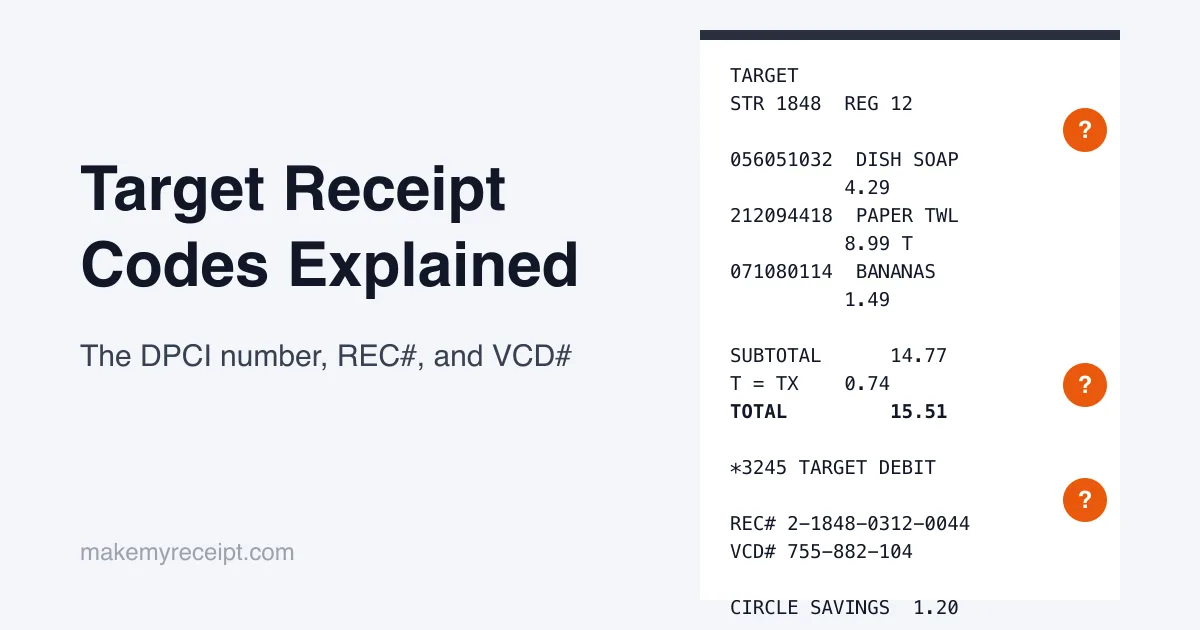
Search for Target receipt codes and you will find confident tables explaining what T, N, X, F, and H mean. Here is what those tables will not tell you: Target has never published a key to its receipt letters, and most of those tables are Walmart's letter meanings with the logo swapped. We checked. The verifiable codes on a Target receipt are not the letters at all. They are the identifiers: the DPCI item number, the REC# and VCD# at the bottom, and the return barcode, and they are genuinely useful once you know what they do.
So this guide inverts the usual format. Identifiers first, folklore honestly labeled after. For the anatomy every receipt shares, see our guide on how to read a receipt; this is the Target-specific chapter.
The DPCI: Target's Own Item Number
The number printed beside each item on a Target receipt is usually not a UPC. It is a DPCI, Target's internal item number, and unlike the tax letters, this one is documented: Target's own supplier onboarding materials define it as Department, Class, Item. The full format is XXX-XX-XXXX: the first three digits are the department, the next two the class within it, the last four the specific item. On receipts it prints as nine digits without hyphens, to the left of the item description.
The DPCI follows the product everywhere in Target's world: shelf labels (just below the price), clearance stickers, sale signs, the packaging of Target-brand products, the in-store price scanners, and the Item Details section in the app. And it is useful in the other direction too. Type a DPCI into the Target app or Target.com search and it resolves to the product, which turns a cryptic receipt abbreviation into a full product name, current price, and aisle location. One UPC can even map to multiple DPCIs in Target's system, which is why the DPCI, not the barcode number, is the identifier Target's tools speak natively.
If a receipt line has you stumped, the DPCI is the decoder. That is the single most practical thing to know about a Target receipt.
The Letters, Honestly
Now the letters next to prices. The circulating decodings say T means taxable, N non-taxable, X tax-exempt, F food, and H health. That list traces back to thin, unsourced guides, and we found no employee documentation, no Target help page, and no credible reporting behind any of it. The strongest statement the evidence supports is this: T marking a taxable item is consistent with how registers generally use letter flags, and everything else is unverified.
There is one exception with a source attached. FSA plan administrators report that Target marks FSA and HSA eligible items with a plus sign (+) rather than a letter, its version of the F flag CVS prints and the H that Walmart uses. We cover that cross-chain system in our Walmart receipt codes guide, which is also where you can see how often Walmart's letters get pasted onto other chains.
When a letter on your Target receipt actually matters, skip the folklore and verify it yourself: total the flagged items, apply your local rate with our sales tax calculator, and compare against the receipt's tax line. Two minutes, and it beats any table on the internet, including ours.
REC#, VCD#, and the Barcode
Near the bottom of a Target receipt sits a long identifier block. According to Target employee accounts, the REC# is an 18-digit receipt identifier and the VCD# a verification code derived from it. Their job is redundancy: when the receipt barcode will not scan at Guest Services, the team member keys in the REC# and VCD# to pull up the transaction, and registers use the same numbers to fix mistakes like a missed coupon or a wrong price. The barcode itself is reported to encode the store, register, transaction number, and date, the same pointer-to-a-transaction role barcodes play on most receipts.
The abbreviations around them (REG for register, STR for store, TM for the team member who rang you up) are standard register conventions, all covered in our receipt abbreviations glossary.
Returns: What Target's Official Policy Actually Says
Receipt lookup is one place we can quote Target directly. Per Target's return policy: "We can also attempt to look up the receipt for store and online purchases in store. Bring the item and the method of payment used to Guest Services within the return window allowed for that item." Lookup works with Target Circle Cards (debit, credit, or Mastercard) and third-party Visa, Mastercard, American Express, and Discover credit cards. Return barcodes and receipts also live in your Target account, for in-store purchases too, if you paid with a card associated to the account or with the app's Wallet.
Two edges worth knowing. If you have no proof of purchase at all, Target says you "may receive a refund in the form of a merchandise return card," store credit rather than cash. And items sold by Target Plus marketplace partners are stricter: proof of purchase is required, full stop. Cash purchases have no account trail, which is the one case where the paper receipt is genuinely irreplaceable.
Circle and the 5% on Your Receipt
Target's loyalty math changed recently, and older guides get it wrong. Target Circle now works as deals applied automatically at checkout once you identify yourself with your phone number at the keypad or the Wallet barcode in the app. The old 1% earnings are gone; Target's own help page announces their removal. So a modern Target receipt shows Circle discounts as reductions in the transaction, not as accumulating reward balances.
The Target Circle Card discount is separate and simpler: 5% off eligible purchases at Target stores and Target.com when you pay with the card. The fine print that shows up on receipts: with split payment, the 5% applies only to the amount charged to the Circle Card, it calculates after other discounts, and categories like pharmacy, gift cards, previous purchases, and taxes and shipping are excluded.
A Word About the Receipt Survey
Target receipts can print an invitation to a guest survey. We looked for the official rules and found something odd: no page on target.com documents the survey at all, while the sites ranking for it are third-party affiliate pages on domains like .cfd and .autos, dressed up to look official. That does not mean the survey on your receipt is fake, but it does mean the only trustworthy pointer is the receipt itself. Type the printed address exactly, and treat any site asking for payment details or excessive personal information as a scam.
Frequently Asked Questions
What is the DPCI number on a Target receipt?
The DPCI is Target's internal item number, short for Department, Class, Item. Its full format is XXX-XX-XXXX: three digits for the department, two for the class, four for the item. On receipts it prints as nine digits without hyphens next to each item. You can type a DPCI into the Target app or Target.com to identify a product, check its price, or find it in a store.
What does T mean on a Target receipt?
T is widely circulated as marking a taxable item, and that reading is plausible, but Target publishes no official key to its receipt letters, and no reliable source documents Target-specific meanings. Many guides quietly copy Walmart's letter meanings onto Target receipts, which is guesswork. If a letter matters to you, verify it against the tax line on your own receipt.
What is the REC# on a Target receipt?
Employee accounts describe the REC# as an 18-digit receipt identifier printed near the bottom of the receipt, with the VCD# as a verification code derived from it. Guest Services uses them to pull up your transaction when the receipt barcode will not scan, and registers use them to fix mistakes like a missed coupon.
Can Target look up my receipt if I lost it?
Often, yes. Target's official policy says Guest Services can attempt to look up store and online purchases if you bring the item and the payment method you used. Lookup works with Target Circle Cards and third-party Visa, Mastercard, American Express, and Discover credit cards. Without any proof of purchase, refunds come as a merchandise return card, and marketplace items from Target Plus partners always require proof of purchase.
How does the Target Circle Card 5% discount show up?
The 5% comes off eligible purchases at Target stores and Target.com when you pay with a Target Circle Card, applied after other discounts. If you split payment between a Circle Card and another method, the 5% applies only to the amount charged to the Circle Card. Some categories are excluded, including pharmacy items, gift cards, and taxes and shipping.
Is the Target receipt survey legitimate?
Be careful. Target receipts can invite you to a guest survey, but we could not find any official Target page documenting the survey or its rules, and the sites ranking for it are third-party affiliate pages on suspicious domains. If you want to take a survey, type the address printed on your receipt exactly, and never enter personal or payment information on a lookalike site.
The Bottom Line
On a Target receipt, trust the numbers and doubt the letters. The DPCI identifies any product better than its abbreviation, the REC# and VCD# are your backup when a barcode fails, and the return barcode ties the slip to an account trail that official policy says Target can search. The letter codes have no published key, so verify rather than believe. To see how these pieces fit together on the printed slip, our Target receipt template rebuilds the format, and the receipt-reading guide covers everything the chains share.
Ready to create your receipt?
Try our free receipt maker with customizable templates.
Open Receipt Builder