
Walmart Receipt Codes Explained: N, X, O, and the TC Number
What the letters on a Walmart receipt mean: N, X, O tax codes, Tax 1 vs Tax 2, ST# OP# TE# TR#, the TC number, and the survey code. Sourced answers.
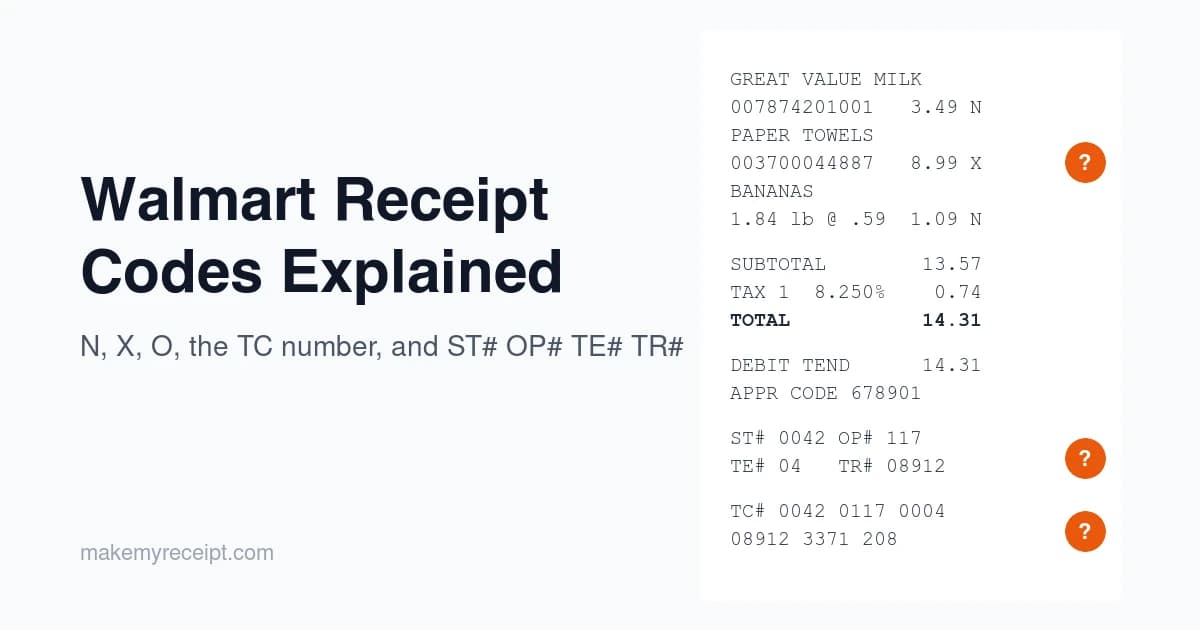
The letters and numbers on a Walmart receipt are among the most-searched receipt codes in the US, and the honest starting point is this: Walmart publishes no official key to any of them. The two letters you can rely on are N (consistently reported as not taxed) and X (taxed). Everything else deserves the confidence label we give it below.
This guide covers the full set of Walmart receipt codes: the tax letters, the Tax 1 and Tax 2 lines, the ST# OP# TE# TR# row, the TC number and barcode, the payment block, and the survey code. It is the Walmart-specific companion to our guide on how to read a receipt, where the general anatomy (and a two minute method for decoding any store's letters) lives.
Every Walmart Receipt Code at a Glance
| Code | Reported meaning | How solid? |
|---|---|---|
| N | Item not taxed | Consistently reported, not official |
| X | Item taxed | Consistently reported, not official |
| O | Disputed: nontaxable sale item vs reduced-rate | Sources contradict each other |
| A, B, P, R, S | Combinations of the store's numbered tax rates | Low confidence, unofficial, varies by state |
| F | Food item, often read as SNAP-eligible | Disputed in detail, food-related in all readings |
| H | Health/pharmacy item | Forum reports only |
| K | Hand-keyed entry (not scanned) | Forum reports only |
| Y | Taxable | Forum reports only |
| ST# | Store number | Commonly reported |
| OP# | Operator (cashier) number | Commonly reported |
| TE# | Terminal (register) number | Commonly reported |
| TR# | Transaction number at that register | Commonly reported |
| TC# | Transaction code, encoded in the barcode | Confirmed by Walmart's own lookup and return flow |
| # ITEMS SOLD | Count of items in the sale | Consistently reported |
| GV | Great Value, Walmart's own brand | GV is officially Walmart's private label |
| ORG | Organic | Consistently reported |
The Tax Letters: N, X, and the O Problem
N and X are the workhorses. Current and former employees have reported the same meanings for years across independent threads: N means no tax was charged on that item, X means it was taxed at the standard rate. Which items get which letter depends on your state and local tax rules, not on Walmart; the same 2-liter soda can be N in one state and X in another.
O is the one to distrust. Some guides say O marks a nontaxable sale item; one bookkeeping guide says it means taxed at a reduced rate. Both cannot be true, no official source exists, and the two camps keep republishing their versions. If the O items on your receipt matter to you, check whether they contributed to the tax line (the method in our main guide takes two minutes).
A, B, P, R, and S are reported as shorthand for combinations of the store's numbered tax rates. The mapping varies by state and nothing official documents it, so we present it as low-confidence.
H, K, and Y come from forum threads only: H as a health or pharmacy flag, K as a hand-keyed (typed, not scanned) entry, Y as taxable. Commonly reported, not confirmed.
Tax 1 and Tax 2: It Depends on Your State
Here is the question the other guides answer with false confidence. Some say Tax 1 is the general merchandise rate and Tax 2 the food rate. Others say Tax 1 is state tax and Tax 2 is county or city tax. Both are real configurations, which is why the guides disagree: the tax lines reflect how the register is set up for your jurisdiction.
Local reporting shows this directly. When Kansas and Alabama phased down their grocery taxes, shoppers suddenly saw two tax lines on receipts because groceries moved to a second, lower-rate line. Meanwhile a new Walmart in Jacksonville confused customers with a "2nd tax" that turned out to be a local levy. Same two lines, different meanings, both correct for their state.
So read Tax 1 and Tax 2 as slots the register fills according to local rules. In a state with one simple sales tax you may only ever see Tax 1; in layered jurisdictions the lines can run to Tax 4. To check whether a line matches your local rate, our sales tax calculator has every state's current rates.
The ST#, OP#, TE#, TR# Line
Near the bottom of the receipt sits a dense row like ST# 0042 OP# 117 TE# 04 TR# 08912. These are commonly reported to mean:
- ST#: the store number (also printed in the header)
- OP#: the operator, meaning the cashier who rang the sale
- TE#: the terminal or register number
- TR#: the transaction number at that register
Walmart doesn't document these fields, but the readings have been consistent across years of independent reports.
The TC Number and the Barcode
The TC# is the one identifier Walmart's own systems vouch for: its receipt lookup and return tools identify a purchase by the transaction code, and a technical decode of the receipt barcode found the barcode encodes exactly that number and nothing else. No items, no prices, no card details: the barcode is a pointer to your transaction in Walmart's database.
One disambiguation you won't find in other guides, and that we know from rebuilding the Walmart receipt format among the 197 formats we maintain: some Walmart card slips print a second, shorter "TC" inside the payment block, a hexadecimal value like TC AF8F12D95E891D4D. That one is not your transaction code. It is the EMV transaction certificate, a cryptogram generated by your card's chip. The TC# that matters for returns is the long numeric code at the bottom, under the barcode.
The Payment Block
Card payments add a block like this:
EFT DEBIT    PAY FROM PRIMARY
US DEBIT    **** **** **** 8867
REF # 012345678900
NETWORK ID. 0001 APPR CODE 678901
AID A0000000980840
- EFT DEBIT: an electronic funds transfer, meaning a debit payment.
- The masked card number: federal law (FACTA) caps receipts at the last 5 digits, no expiration date.
- REF #: the payment processor's reference number, the identifier your bank uses in a dispute.
- NETWORK ID and APPR CODE: which payment network routed the transaction and the approval code your bank returned.
- AID: the EMV chip application identifier, standardized by EMVCo.
Our receipt abbreviations glossary covers each of these fields, and their cousins on other chains' receipts, in one reference.
Item Lines: UPCs, GV, and ORG
The 12-digit number printed beside each item is the product's UPC, the same number in the shelf barcode. If an abbreviated item name stumps you, typing that number into Walmart.com's search bar will usually pull up the product.
The name abbreviations are mostly space-saving: GV is Great Value, Walmart's own brand; ORG means organic; abbreviations like PK and BTL commonly mark pack sizes. Weighed items print the weight and per-pound rate on their own line, and it's worth a glance: consumer reporting has covered weight-mislabeling disputes on by-the-pound items, and that line is the only place you can check the math.
The Survey Code: Yes, the $1,000 Is Real
The block reading "chance to win $1000" with an ID number is the Walmart Customer Satisfaction Sweepstakes, and unlike the letter codes, this one has official documentation: the rules are published on corporate.walmart.com. It runs quarterly; each period awards five $1,000 Walmart gift cards and 750 $100 gift cards. You enter the code from your receipt at survey.walmart.com within one week of the receipt date, and it's limited to one prize per household.
One related note: if you pay with Walmart Pay in the app, there is no paper receipt at all. The e-receipt lands in the app, codes and all.
Frequently Asked Questions
What does N, X, or O mean on a Walmart receipt?
N and X are the two letters you can rely on: N is consistently reported to mean the item was not taxed, and X that it was taxed. O is genuinely disputed. Some guides say it marks a nontaxable sale item, others say taxed at a reduced rate, and Walmart has never published a key. Treat O as store-and-state specific.
What are Tax 1 and Tax 2 on a Walmart receipt?
It depends on your state's setup. In many states, Tax 1 is the general merchandise rate and Tax 2 a reduced grocery rate. In others, the lines split state tax from county or city tax, and layered jurisdictions can print up to Tax 4. The lines are register configuration for your location, not a fixed national meaning.
What is the OP number on a Walmart receipt?
OP# is commonly reported to be the operator number, identifying the cashier who rang up the sale. It prints in the same line as ST# (store number), TE# (terminal or register number), and TR# (the transaction number at that register). Walmart does not officially document these fields.
What is the TC number on a Walmart receipt?
The TC# is Walmart's transaction code, the long number printed under the barcode. It uniquely identifies your purchase, and the barcode encodes the same number so an associate can scan it for a return. Don't confuse it with the shorter hexadecimal TC line some card slips print, which is a chip-security value from the EMV system.
What does F mean on a Walmart receipt?
Most guides read F on Walmart receipts as marking food items, and some specifically as SNAP-eligible food. One bookkeeping guide instead treats F as a reduced-tax-rate code. Every published reading is food-related, but Walmart publishes no key, so treat F as a food flag whose exact meaning depends on your store and state.
What do H, K, and Y mean on a Walmart receipt?
These are forum-tier reports, not confirmed meanings: H is commonly reported as a health or pharmacy item flag, K as a hand-keyed entry (the cashier typed the code instead of scanning), and Y as taxable. Treat all three as unverified. If the letter matters to you, compare flagged items against the tax line to see how your store uses it.
Will my card number show on a Walmart receipt?
No. Federal law (the FACTA truncation rule, 15 U.S.C. 1681c(g)) limits electronically printed receipts to at most the last 5 digits of the card number, with no expiration date, and Walmart receipts typically show only the last 4. If you paid with a phone wallet, the digits may belong to the wallet's virtual card number and may not match your physical card.
Is the $1,000 survey on my Walmart receipt legit?
Yes. The block inviting you to a survey for a chance to win $1,000 is the Walmart Customer Satisfaction Sweepstakes, run quarterly under official rules published on corporate.walmart.com. Each period awards five $1,000 Walmart gift cards and 750 $100 gift cards. You enter the code from your receipt at survey.walmart.com within one week of the receipt date.
The Bottom Line
Trust N and X, treat O and the exotic letters as unsettled, read Tax 1 and Tax 2 as your state's configuration rather than fixed categories, and remember that the TC# under the barcode is the number that identifies your purchase. When a Walmart letter still puzzles you, the two minute decode method in our receipt-reading guide settles what any table can't: how your store, in your state, actually uses it.
Ready to create your receipt?
Try our free receipt maker with customizable templates.
Open Receipt Builder