
Receipt Abbreviations: What Every Code and Letter Means
A complete glossary of receipt abbreviations: SC, TEND, APPR, AID, PLU, UPC, ST#, TC#, VOID, and more, organized by where they appear on the receipt.
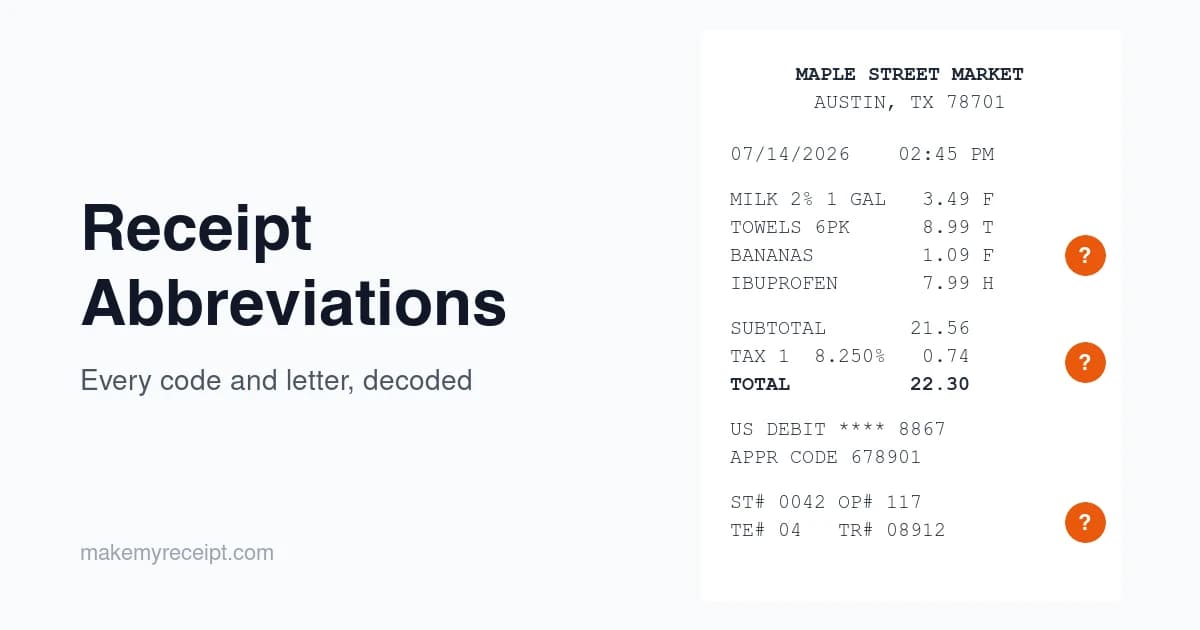
Receipt abbreviations fall into two groups: standardized codes that mean the same thing everywhere (UPC, PLU, APPR, AID, the masked card number) and store dialect set by each retailer's register system (the single letters like F, N, X, and T). This glossary covers both and is organized the same way your receipt is: top to bottom. Rebuilding receipt layouts for 197 US retailer formats taught us which is which; the letters are the one element that never transfers from chain to chain.
For the full walkthrough of how a receipt is structured, start with our guide on how to read a receipt. This page is the reference companion: every abbreviation, one place.
The Quick A to Z Table
| Abbreviation | Meaning | Standardized? |
|---|---|---|
| AID | EMV chip Application Identifier | Yes (EMVCo) |
| AMT TEND | Amount tendered (what you handed over) | Convention |
| APPR / AUTH | Card approval code from your bank | Yes (card networks) |
| BAL | Balance remaining (gift card or EBT) | Convention |
| CHG DUE | Change due | Convention |
| DEBIT TEND | Amount paid by debit card | Convention |
| DEPT | Department code | Store-internal |
| EBT / FS | SNAP payment or SNAP-eligible item | Federal program, store formatting |
| F, N, X, O, T, B, H | Per-item tax/eligibility letters | Store dialect, varies by chain |
| GC | Gift card | Convention |
| MC / MFR | Manufacturer coupon | Convention |
| MID | Merchant ID | Yes (processor-assigned) |
| OP# | Operator (cashier) number | Convention (Walmart-style) |
| PLU | Price Look-Up code on produce | Yes (IFPS) |
| QTY | Quantity | Convention |
| REF # / RRN | Payment reference number | Yes (processors) |
| SC | Store coupon | Convention |
| SKU | Stock Keeping Unit (retailer's item code) | Store-internal |
| ST# | Store number | Convention (Walmart-style) |
| SUBTOT / SUBTOTAL | Sum of items before tax | Universal |
| TC# | Transaction code (Walmart) | Store-specific |
| TE# | Terminal (register) number | Convention (Walmart-style) |
| TEND | Tendered (payment given) | Convention |
| TID | Terminal ID (payment system) | Yes (processor-assigned) |
| TR# | Transaction number | Convention (Walmart-style) |
| TVR / TSI | EMV chip diagnostic fields | Yes (EMV) |
| UPC | Universal Product Code | Yes (GS1) |
| VOID | Line or sale cancelled before settlement | Universal |
XXXX / **** | Card number masking | Federal law (FACTA) |
Everything marked "convention" is widely used across chains, though not guaranteed everywhere; everything marked "store dialect" needs checking against your specific store, and the sections below explain how.
Item Codes: UPC, PLU, SKU, and DEPT
- UPC (Universal Product Code): the 12-digit product number from the barcode, standardized by GS1. The long number printed next to items on big-box receipts is usually this.
- PLU (Price Look-Up): the 4 or 5 digit produce codes standardized by the International Federation for Produce Standards. Bananas are 4011; a leading 9 means organic (94011).
- SKU (Stock Keeping Unit): the retailer's private inventory code. Two chains can use completely different SKUs for the same product.
- DEPT: a department code grouping the item by store section. The numbering is internal to each chain.
- QTY and weight lines:
2 @ 1.99means two units at $1.99;1.84 lb @ 0.59/lbis a weighed item.
Price Adjustments: SC, MC, VOID, and Savings Lines
- SC commonly means store coupon, and MC or MFR a manufacturer coupon. The distinction matters to the store's accounting; to you, both are negative lines reducing the total.
- VOID means the line or transaction was cancelled before the payment settled. A void is not a refund: a refund returns money after the sale completed.
- YOU SAVED / MEMBER SAVINGS: a loyalty recap of discounts, not an additional discount.
- Bottle deposit lines appear in container-deposit states, itemized separately from the product's price.
The Money Block: SUBTOTAL, TAX, TEND, and CHANGE
- SUBTOTAL: your items summed before tax.
- TAX 1 / TAX 2: separate tax lines, usually stacked jurisdictions or different rate categories (a general rate and a lower grocery rate, for example). Check the math with our sales tax calculator if a line looks off.
- TOTAL: subtotal plus tax minus discounts. This is the number that matters for expense records.
- TEND / AMT TEND: what you handed over, by payment method. CHG DUE is your change. GC marks a gift card, and BAL its remaining balance. A split tender (two payment methods) prints one line per method.
- CASH BACK: extra cash added to a debit purchase, itemized so the total reflects it.
The Payment Block: APPR, AID, REF #, MID, and the Masked Card
These fields are the most standardized part of any receipt:
- APPR / AUTH: the approval code returned by your card's issuing bank; Visa's merchant rules instruct merchants to record it on the receipt.
- AID: the EMV Application Identifier naming the chip application used, registered through EMVCo.
- REF # / RRN: the processor's retrieval reference number, the identifier your bank uses in a dispute.
- MID / TID: merchant and terminal IDs assigned by the payment processor.
- TVR / TSI: chip diagnostic fields some slips print. Safe to ignore.
**** 8867: card masking required by the FACTA truncation rule, which caps receipts at the last 5 digits, no expiration date.
Transaction IDs: ST#, OP#, TE#, TR#, and TC#
On Walmart-style receipts these are commonly reported to mean store number, operator (cashier), terminal, and transaction number; the TC# is the transaction code encoded in the barcode. None of them are officially documented by the retailer, and our Walmart receipt codes guide covers the whole set, including the tax letters, in detail.
The Letters: F, N, X, O, T, B, and H
The single letters after prices are the least standardized thing on any receipt. N and X are consistently reported as not-taxed and taxed on Walmart receipts; FSA administrators report F as marking SNAP-eligible food at Kroger, while at CVS the same letter flags FSA-eligible items; H shows up in forum reports as a pharmacy or health flag, unconfirmed. No retailer publishes an official key. Rather than trusting any table, use the two minute decode method in our receipt-reading guide: find one item you know is taxed, one you know is not, and check their letters against the tax line.
Special Flags: EBT, FS, and Loyalty
- EBT tender lines pay via SNAP; federal rules require the receipt to show your remaining balance, which is why BAL prints below it.
- FS commonly flags a SNAP-eligible (food stamp) item on grocery receipts, a formatting cousin of the F that FSA administrators report at Kroger.
- Loyalty numbers usually print masked, with points earned or a savings recap.
- DUPLICATE / REPRINT typically marks a reprinted copy of the original receipt, as on a grocery receipt reprint from customer service.
Frequently Asked Questions
What does SC mean on a receipt?
On most grocery and retail receipts, SC commonly stands for store coupon, distinguishing the store's own discount from a manufacturer coupon (often printed as MC or MFR). It is a register convention rather than a standard, so a few chains use SC differently. The giveaway is a negative amount on the same line.
What is the difference between subtotal and total on a receipt?
The subtotal is the sum of your items before tax. The total is what you actually paid: subtotal plus each tax line, minus any discounts applied after the subtotal. If the two numbers match and no post-subtotal discount was applied, nothing in your basket was taxed. The gap between them should equal the tax lines added together.
What does TEND mean on a receipt?
On most receipts, TEND is short for tendered, meaning the payment you handed over. CASH TEND 25.00 means you gave $25 in cash, and DEBIT TEND means the amount was paid by debit card. The word tender is register-speak for a payment method, which is why gift cards and EBT also appear as tender lines.
What does DEPT mean on a receipt?
DEPT typically stands for the department code, a number or short label the register uses to group items by store section, such as produce, hardware, or pharmacy. Retailers use department codes for their own inventory and reporting, so the numbering is internal to each chain and not something you can look up externally.
What are TVR and TSI on a card receipt?
They are diagnostic fields from the EMV chip-card system that some card slips print: TVR is the Terminal Verification Results and TSI is the Transaction Status Information. They record how the terminal processed the chip transaction. They are useful to payment technicians, and safe for you to ignore.
Are receipt abbreviations the same at every store?
No. Payment-block fields like APPR, AID, and the masked card number are standardized across the industry, and UPC and PLU item codes follow published standards. But single-letter tax and eligibility flags are set by each retailer's register system, so the same letter can mean different things at different chains.
One Habit Worth Keeping
When an abbreviation on a receipt matters (a deduction, a dispute, a return), decode it while the purchase is fresh: the transaction identifiers near the barcode are what the store and your bank will ask for, and receipts and invoices carry different legal weight in your records. For the letters, check them against your own tax line rather than trusting any table, ours included.
Ready to create your receipt?
Try our free receipt maker with customizable templates.
Open Receipt Builder