
Receipt vs Invoice: Key Differences and When to Use Each
Confused about receipts vs invoices? Learn the key differences, when to use each, and get free templates. Clear explanation for small businesses.
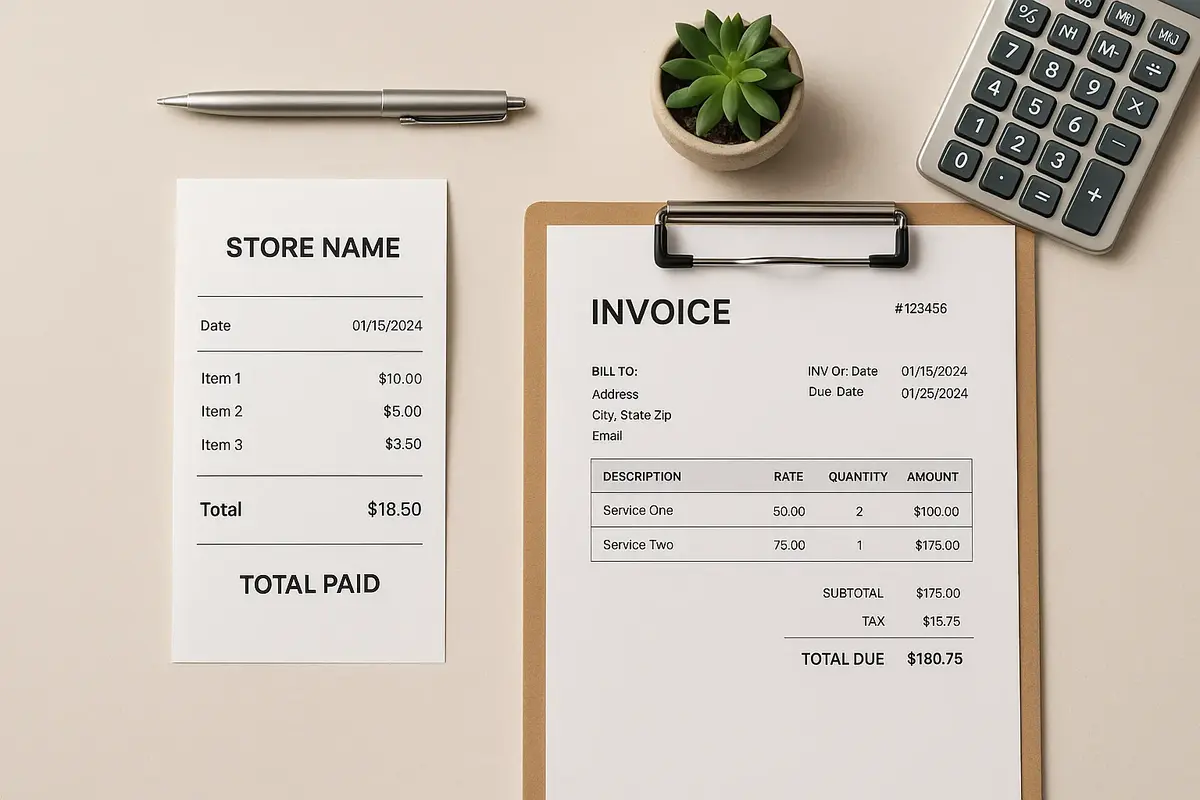
Do you need to send a receipt or an invoice? They look similar enough that it's easy to grab the wrong one, and plenty of business owners do.
The difference comes down to timing. An invoice asks for payment. A receipt confirms payment happened. That's it. But picking the wrong document can delay your payments or confuse your customers, so it's worth getting right.
Quick answer: the receipt vs invoice key difference
Here's the simplest way to remember the difference between a receipt and an invoice:
- Invoice = Request for payment (issued BEFORE payment)
- Receipt = Proof of payment (issued AFTER payment)
An invoice tells your customer "here's what you owe me." A receipt tells your customer "here's confirmation that you paid."
That's the core receipt vs invoice distinction. Everything else flows from this fundamental difference in timing and purpose. When deciding which is correct for your situation, ask yourself: has payment already happened?
What is an invoice?
An invoice is a commercial document that requests payment for goods or services. It's essentially a bill you send to your customer asking them to pay you.
When invoices get sent
You issue an invoice before payment happens. Common scenarios include:
- After completing a service or project
- When delivering products on credit terms
- At regular intervals for ongoing work (monthly retainer, for example)
- When a deposit or milestone payment comes due
What invoices include
A proper invoice contains:
- Your business name and contact information
- Customer's name and contact information
- Unique invoice number
- Invoice date and payment due date
- Itemized list of products or services
- Quantities and unit prices
- Subtotal, taxes, and total amount due
- Payment terms (Net 30, due on receipt, and so on)
- Accepted payment methods
- Bank details or payment instructions
The purpose of invoices
Invoices serve several important functions:
Legal documentation: An invoice creates a formal record of the transaction agreement between you and your customer.
Payment tracking: Invoice numbers help you track outstanding payments and follow up on overdue accounts. SCORE's guide to invoicing covers best practices for getting paid on time.
Accounting records: Invoices provide the documentation needed for accounts receivable and revenue tracking.
Tax compliance: Businesses need invoices to document income for tax purposes.
What is a receipt?
A receipt is a document that confirms payment has been made. It serves as proof that a transaction was completed and money changed hands.
When receipts get issued
You provide a receipt after payment happens. Common scenarios include:
- Immediately after a point-of-sale transaction
- After receiving payment on an invoice
- When accepting cash payments
- After processing a credit card transaction
- When a customer requests documentation of their purchase
What receipts include
A proper receipt contains:
- Your business name and contact information
- Date and time of transaction
- Description of items or services purchased
- Quantities and prices
- Subtotal, taxes, and total paid
- Payment method used
- Transaction or receipt number
- Optional: return policy, thank you message
The purpose of receipts
Receipts serve different functions than invoices:
Proof of purchase: Receipts verify that the customer paid for specific goods or services.
Return documentation: Customers need receipts to process returns or exchanges.
Expense tracking: Receipts help customers (and your business) document expenses for reimbursement or tax deductions.
Record keeping: Both parties have documentation of the completed transaction.
If you need to create professional receipts for your business, MakeMyReceipt offers a sales receipt template that includes all standard fields. You can customize it with your business details and download instantly.
Side-by-side comparison: receipt vs invoice
Here's a direct receipt vs invoice comparison to clarify the difference between receipt and invoice documents:
| Feature | Invoice | Receipt |
|---|---|---|
| Timing | Before payment | After payment |
| Purpose | Request payment | Confirm payment |
| Issued by | Seller/service provider | Seller/service provider |
| Given to | Customer/client | Customer/client |
| Payment status | Payment pending | Payment completed |
| Legal function | Creates payment obligation | Proves payment made |
| Contains due date | Yes | No |
| Contains payment method | Expected methods listed | Actual method used |
| Unique identifier | Invoice number | Receipt/transaction number |
When to use an invoice
Invoices work best in situations where payment doesn't happen immediately. Here's when you should use an invoice instead of a receipt:
Service businesses
If you provide services like consulting, design, repairs, or professional work, you typically complete the work before getting paid. An invoice documents what you did, how much it costs, and when payment is expected.
Example: A freelance designer completes a logo project. They send an invoice listing the design services, project rate, and Net 30 payment terms.
B2B transactions
Business-to-business sales usually operate on credit terms. The scale of B2B payments is massive — ACH transfers alone moved $91.8 trillion, with invoices driving the majority of these transactions. Invoices allow the purchasing business to process payment through their accounts payable system.
Example: A supplier delivers inventory to a retail store. They send an invoice with Net 60 terms, giving the retailer time to sell products before paying.
Ongoing projects and retainers
For work that spans multiple weeks or months, invoices help you bill for completed milestones or regular intervals.
Example: A marketing agency bills monthly retainer clients at the beginning of each month with an invoice outlining the services included.
Large purchases requiring payment terms
When the purchase price is substantial, buyers often need time to arrange payment. Invoices formalize the transaction and provide payment flexibility.
Example: A construction contractor completes a renovation phase and sends an invoice for that milestone payment.
When to use a receipt
Receipts are the right choice when payment happens at the time of transaction. Here's when you need a receipt instead of an invoice:
Point-of-sale transactions
Retail stores, restaurants, and other businesses where customers pay immediately should provide receipts right after the transaction. Since credit and debit cards now account for 65% of consumer payments, most POS transactions automatically generate receipts.
Example: A customer buys groceries and receives a receipt listing all items, tax, and total paid at checkout.
Cash transactions
Cash payments especially need documentation. A receipt protects both parties by creating a record of what was paid.
Example: A landscaper receives cash payment after mowing a lawn. They provide a receipt confirming the service and payment amount.
Cash payments are especially important to document because the IRS treats undocumented cash income as a red flag during audits.
After an invoice gets paid
Once a customer pays an invoice, you should provide a receipt confirming their payment was received. This closes the loop on the transaction.
Example: A client pays their consulting invoice via bank transfer. The consultant sends a receipt acknowledging receipt of payment.
Customer requests
Sometimes customers need receipts for their own records, even for simple transactions. Always provide a receipt when asked.
Example: An employee makes a work purchase and needs a receipt for expense reimbursement from their employer.
Expense documentation
When transactions need to be documented for expense reports, tax records, or reimbursement claims, receipts provide the necessary proof.
Example: A business traveler needs hotel and transportation receipts to submit with their expense report.
Do you need both a receipt and an invoice?
In many business situations, you'll need both documents. Understanding when to use receipt vs invoice documents is key since they serve different purposes at different points in the transaction.
The typical invoice-to-receipt workflow
Here's how invoices and receipts work together:
- You complete work or deliver goods to your customer
- You send an invoice requesting payment
- Customer reviews the invoice and arranges payment
- Customer sends payment via the agreed method
- You receive payment and verify the amount
- You send a receipt confirming payment received
Both documents become part of the transaction record for accounting and tax purposes.
When you only need a receipt
For immediate point-of-sale transactions, you can skip the invoice and go straight to a receipt. The customer pays right away, so there's no need to request payment separately.
Examples:
- Retail purchases
- Restaurant meals
- Quick services (car wash, haircut)
- Cash sales
When you only need an invoice
Some business situations call for an invoice without a separate receipt. When payment is made via methods that create their own transaction record (like bank transfers or credit card processing), the invoice marked "PAID" may suffice.
However, providing a receipt on request is always good practice.
Can a receipt serve as an invoice?
Can a receipt be an invoice? This is a common question, especially for simple transactions. The answer: sometimes, but understanding the receipt and invoice difference matters for professional business practices.
When a receipt can work like an invoice
In some retail contexts, a receipt functions as both. The customer pays immediately, so there's no gap between requesting payment and confirming it. The receipt documents what was purchased and how much was paid.
When you need separate documents
For business transactions, especially B2B dealings, you'll want separate documents. Here's why:
Accounting purposes: Invoices go into accounts receivable. Receipts confirm when receivables become collected revenue. These are different accounting entries.
Tax documentation: The IRS requires businesses to keep records that support income and expenses. Having both invoices and receipts creates a clear paper trail.
Legal clarity: Separate documents make it clear what was agreed (invoice) versus what was paid (receipt).
Professional standards: Using proper documentation builds trust with customers and makes your business look more established.
Creating professional receipts for your business
Now that you understand when to use receipts, let's look at what makes a receipt professional and trustworthy.
Essential receipt elements
Every business receipt should include:
- Business identification: Name, address, phone number
- Transaction date: When the purchase happened
- Items purchased: Clear descriptions with quantities
- Pricing: Unit prices and line totals
- Tax information: Tax rate and amount charged
- Total paid: Grand total after tax
- Payment method: How the customer paid
- Transaction number: Unique identifier for tracking
Optional but helpful elements
These additions make receipts more useful:
- Return policy: Sets customer expectations
- Thank you message: Personal touch that builds goodwill
- Barcode or QR code: Makes lookups and returns easier
- Cashier or server ID: Tracks who processed the transaction
Using receipt templates
Creating receipts from scratch takes time and invites inconsistency. Templates solve both problems by giving you a starting point with all the standard sections already in place.
MakeMyReceipt offers 50+ professional receipt templates covering different business types. Customize any template with your business details and download in seconds.
Common mistakes to avoid
Understanding the difference between receipts and invoices helps you avoid these common errors:
Sending a receipt instead of an invoice
If you need to request payment, send an invoice. A receipt implies payment already happened, which can confuse customers and delay your payment.
Not providing receipts for cash payments
Cash transactions need documentation more than card payments do. Always offer a receipt for cash sales.
Using inconsistent numbering
Both invoices and receipts should have unique numbers. Sequential numbering helps with tracking and looks more professional.
Missing required information
A receipt missing key details (date, items, total) doesn't serve its purpose as proof of purchase. Use templates to ensure you include everything needed.
Mixing invoice and receipt formats
Keep these documents distinct so their purpose is clear. An invoice that looks like a receipt (or vice versa) creates confusion.
Record keeping best practices
Proper documentation with both invoices and receipts supports good business practices. The Small Business Administration recommends keeping organized financial records for tax compliance and business management.
How long to keep records
- General rule: Keep business records for at least 3 years
- Tax documentation: Keep for 7 years to be safe
- Major purchases: Keep indefinitely for warranty and depreciation records
The IRS recommends keeping records for at least 3 years from the date you file, though some situations require longer retention.
Organizing your documents
For each transaction, your records should include:
- The original invoice (if applicable)
- Payment confirmation or bank record
- The receipt issued
- Any related correspondence
Digital storage makes this easier. Save PDFs in organized folders by date, customer, or transaction type.
Frequently asked questions
What is the main difference between a receipt and an invoice?
The main difference is timing. An invoice requests payment before it happens (sent to ask for money). A receipt confirms payment after it's received (sent to prove money was paid). Invoices say "you owe this," while receipts say "you paid this."
Can I use a receipt instead of an invoice?
In immediate point-of-sale transactions where the customer pays right away, a receipt can serve both purposes. However, for B2B transactions, service work, or any situation where payment happens after delivery, you should use a proper invoice to request payment, then issue a receipt once paid. Our guide on how to make a receipt covers what that receipt needs to include.
Do I need to provide both an invoice and a receipt?
For most business transactions beyond simple retail sales, yes. The invoice documents what's owed and when payment is due. The receipt confirms payment was received. Both become part of your financial records for accounting and tax purposes.
Is an invoice the same as a bill?
Yes, in most contexts an invoice and a bill refer to the same thing: a document requesting payment for goods or services. "Invoice" is more commonly used in business contexts, while "bill" is often used for utilities and recurring services.
When should I issue a receipt for cash payments?
Always. Cash transactions especially need documentation since there's no automatic bank record. Provide a receipt immediately after receiving cash payment to protect both parties and create a proper paper trail.
Conclusion
Understanding receipt vs invoice differences comes down to timing: invoices request payment before it happens, receipts confirm payment after it's received. The difference between receipt and invoice usage is fundamental to professional business operations, and many situations call for using both documents.
Key takeaways:
- Use invoices when you need to request payment (before money changes hands)
- Use receipts when you need to confirm payment (after money changes hands)
- For immediate point-of-sale transactions, receipts are usually sufficient
- For B2B and service transactions, you'll typically need both
- Professional documentation builds trust and keeps your records organized
Ready to create professional receipts for your business? Our free receipt maker makes it simple with customizable templates that include all the standard fields. Pick a template, add your details, and download in seconds. No account required.
Ready to create your receipt?
Try our free receipt maker with customizable templates.
Open Receipt Builder