
How to Create a Receipt for Cash Transactions: Complete Guide
Learn how to create professional cash receipts with all required elements for IRS compliance. Includes templates, examples, and best practices for small businesses.
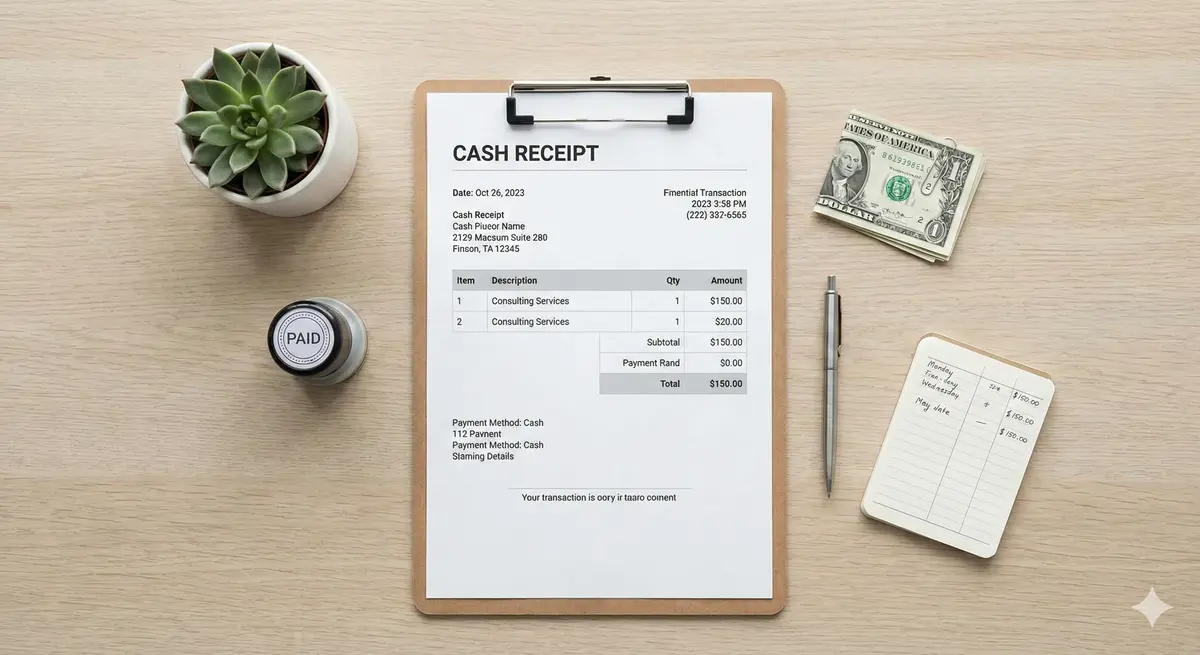
A customer hands you $200 in cash for a job well done. You pocket the money, shake hands, and move on to the next task. Three months later, they're claiming they paid $250 and want a partial refund. Without a receipt, it's your word against theirs.
Cash transactions are convenient, but they don't leave a trail. No bank record, no card statement, no automatic proof that money changed hands. That's why a proper cash receipt matters more than you might think.
For small business owners, freelancers, and contractors who accept cash payments, creating receipts isn't just good practice—it protects your business and your customers. The right documentation helps you track income for taxes, gives customers proof of purchase, and creates a paper trail when disputes come up. This guide focuses on the cash-specific details; if you're new to writing receipts entirely, start with our general guide on how to make a receipt.
This guide walks you through everything: what goes on a cash receipt, what the IRS expects, and the fastest ways to create professional receipts for your business.
This article provides general information only and is not legal, tax, or financial advice. Consult a qualified professional for guidance specific to your situation.
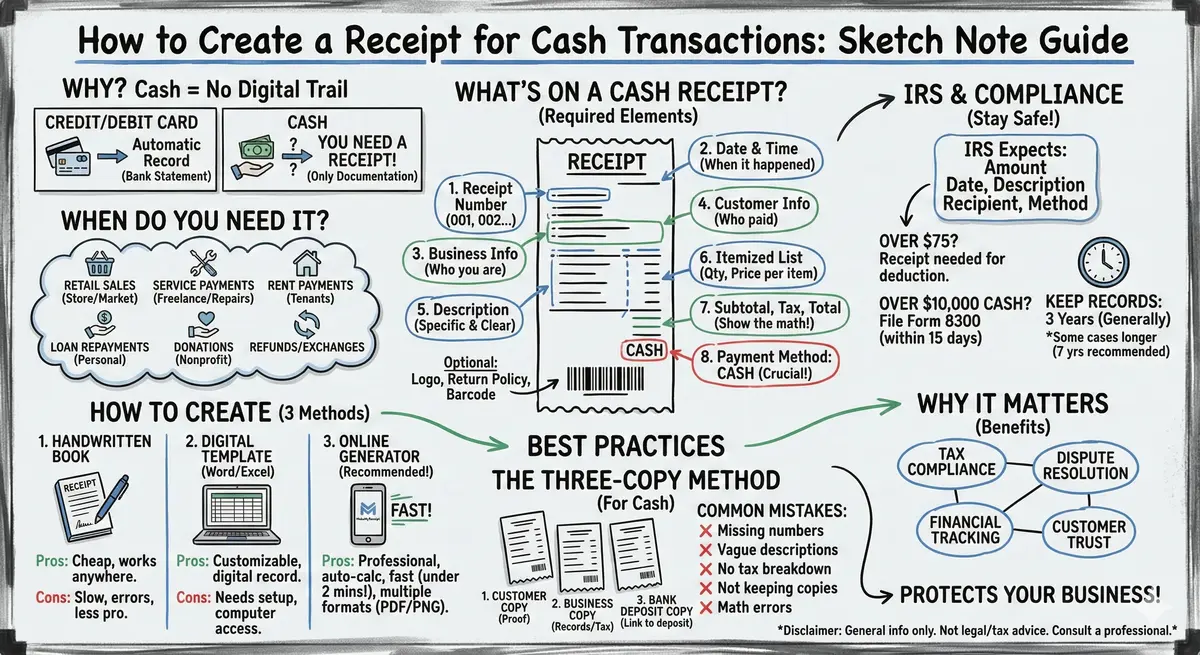
What is a cash receipt?
A cash receipt is a document that confirms a cash payment was made and received. It serves as proof of the transaction for both the business and the customer. Unlike credit card or digital payments, cash transactions have no automatic record. The receipt becomes the sole evidence that money changed hands.
Cash receipts document the essential details: who paid, who received the payment, how much, when, and for what. They matter for accounting, tax reporting, and dispute resolution.
Cash receipt vs sales receipt
While the terms get used interchangeably, there's a practical difference. A sales receipt documents any sale regardless of payment method. A cash receipt specifically confirms payment was made in cash.
This distinction matters for your bookkeeping. Cash payments need separate tracking from card transactions because they require different handling for deposits, reconciliation, and sometimes tax reporting. When you create a cash receipt, you're creating a record that fills the documentation gap left by the absence of a bank or card processor record. Not sure when to use a receipt vs other documents? Check out our guide on receipt vs invoice differences.
When do you need a cash receipt?
Any time your business receives cash, you should provide a receipt. This applies to more situations than you might think.
Common cash transaction scenarios
Retail sales When customers pay cash for products at your store, market booth, or pop-up shop. This includes everything from convenience stores to farmer's markets to garage sales if you're running them as a business.
Service payments When clients pay cash for services you've performed. This includes freelance work, consulting, home repairs, cleaning services, tutoring, and any other service business.
Rent payments When tenants pay rent in cash. Landlords should always provide receipts for cash rent payments, and many states legally require it. Both parties need documentation for their records. Our guide on how to write a rent receipt covers the rental-specific fields and state rules.
Loan repayments When someone pays back money they borrowed. Personal loans often happen in cash, and receipts protect both the lender and borrower.
Donations received When your nonprofit or organization receives cash donations. Donors need receipts for tax deductions, and you need records for your books.
Refunds and exchanges When you return cash to a customer. Document refunds just as carefully as sales.
If you're receiving cash regularly, a cash receipt template saves time and ensures consistency.
What information should be on a cash receipt?
Every cash receipt needs certain information to be valid and useful. Skip any of these, and you might have problems with record keeping, tax compliance, or customer disputes.
Required elements
Receipt number A unique identifier for each receipt. Sequential numbering (001, 002, 003) helps you track transactions and spot if any receipts go missing.
Date and time When the transaction happened. Include both date and time when possible. This matters for record matching and if disputes arise later.
Business information Your business name, address, and contact information. The customer needs to know who they paid, and you need your records to clearly identify your business.
Customer information At minimum, get the customer's name. For larger transactions or ongoing business relationships, include their address and contact details.
Description of goods or services What the customer paid for. Be specific enough that both parties can identify the transaction later. "Consulting services" is vague. "Website design consultation, 2 hours" is clear. For detailed guidance on itemization, see our guide on how to create an itemized receipt.
Itemized list with quantities and prices Break down what was purchased, how many, and the price per item. This level of detail prevents misunderstandings and helps with returns or warranty claims.
Subtotal, tax, and total Show the math. Subtotal before tax, applicable tax amount, and the grand total the customer paid.
Payment method Explicitly state "Cash" as the payment method. This distinguishes the receipt from card transactions and matters for your accounting.
Signature (when applicable) For larger transactions or service work, consider having both parties sign. This adds a layer of verification.
Optional but recommended elements
Business logo Adds professionalism and helps customers remember who they bought from.
Return policy Set expectations upfront. Include your return or refund policy directly on the receipt.
Barcode or QR code Makes inventory tracking and receipt lookup faster. Useful if you process many transactions.
Thank you message A simple "Thank you for your business" adds a personal touch that customers notice.
Terms and conditions Any relevant policies about warranties, guarantees, or limitations.
IRS requirements for cash receipts
The IRS has specific expectations for business documentation, including cash receipts. Understanding the scale helps — sole proprietors claimed over $580 billion in deductions, and proper cash receipt documentation is essential for substantiating those claims. Understanding these requirements helps you stay compliant and avoid problems if you're ever audited. For a complete breakdown of what the IRS expects, see our detailed guide to IRS receipt requirements.
What the IRS expects
According to IRS guidelines, valid receipts for business transactions should generally include these elements:
- The amount paid
- The date of payment
- A description of what was purchased
- Who received the payment
- The payment method
Here's what a compliant cash receipt looks like with all five elements:
SMITH'S LAWN CARE
456 Oak Street
Austin, TX 78701
(512) 555-0123

Date: 12/15/2024
Receipt #: 1047

SERVICES PROVIDED:
Lawn Mowing (0.5 acre)      1    $65.00
Hedge Trimming              1    $45.00
Leaf Cleanup                1    $30.00

Subtotal:                       $140.00
Tax (0%):                         $0.00
Total:                          $140.00

Payment Method: CASH
Amount Received: $140.00

Customer: John Anderson

Thank you for your business!
This receipt includes the amount ($140.00), date (12/15/2024), description of services, business name (who received payment), and payment method (cash).
For business expense deductions, the IRS generally requires receipts for purchases over $75 (with some exceptions). Below that threshold, you may be able to use other records like credit card statements or a log, but receipts are still recommended. Requirements can vary by expense type, so verify current IRS guidelines for your specific situation. Learn more about which expenses fall into different tax categories in our business expense categories guide.
Cash transactions over $10,000 trigger additional requirements. Businesses that receive more than $10,000 in cash in a single transaction (or related transactions) must file Form 8300 with the IRS within 15 days. This applies to cash, cashier's checks, and money orders.
How long to keep cash receipts
The IRS generally recommends keeping records for at least three years from the date you file your tax return. However, several situations may extend this period:
Seven years: If you claim a loss from worthless securities or bad debt deduction.
Six years: If you underreport income by more than 25%.
Indefinitely: If you file a fraudulent return or don't file at all.
For practical purposes, many accountants recommend keeping receipts for seven years to cover most situations. Store copies digitally when possible. Physical receipts fade, get lost, and take up space. A PDF backup of every receipt protects you if the originals become unreadable. For a complete retention timeline by receipt type, see our how long to keep receipts guide.
For more on record keeping requirements, see IRS Publication 583.
How to create a cash receipt: 3 methods
You have several options for creating cash receipts. Each has trade-offs in terms of cost, convenience, and professionalism.
Method 1: Handwritten receipt books
The classic approach. Buy a carbonless receipt book from any office supply store, fill out the information by hand, and tear off the customer copy.
When to use: Low-volume cash transactions, situations where you don't have access to a printer or computer, or when customers expect a handwritten receipt (some markets, small in-person services).
Pros:
- No technology required
- Works anywhere
- Inexpensive to start
- Creates automatic duplicate copy
Cons:
- Time-consuming for each transaction
- Prone to math errors
- Looks less professional
- Hard to read if handwriting is unclear
- No digital backup
Best practice: Use a receipt book with pre-numbered receipts. This prevents gaps in your records and makes bookkeeping easier.
Method 2: Digital templates (Word or Excel)
Create a receipt template in Word, Excel, or Google Docs. Fill it in for each transaction, then print or email it to the customer.
When to use: Moderate transaction volume, businesses with computer access, situations requiring customization for each receipt.
Pros:
- Customizable to your business
- Digital record automatically created
- Can include logos and branding
- Reusable template
Cons:
- Requires setting up formulas for calculations
- Need to access computer for each receipt
- Printing adds time and cost
- Plain document styling looks generic
Best practice: Set up formulas in Excel or Sheets so totals calculate automatically. This reduces errors and saves time.
Method 3: Online receipt generator (recommended)
Receipt and bill generators like MakeMyReceipt let you create professional receipts in minutes using pre-built templates. Select your template, customize the details, and download in your preferred format.
When to use: Any business that wants professional-looking receipts quickly. Especially useful for small businesses, freelancers, and service providers.
Pros:
- Templates with all required fields included
- Auto-calculated totals and tax
- Professional thermal paper styling
- Multiple export formats (PNG, PDF, JPEG)
- Free to use
- No software to install
- Works on any device
Cons:
- Requires internet connection
How to create a cash receipt with MakeMyReceipt:
- Go to the Cash Receipt template
- Add your business name, address, and contact details
- Enter the transaction date and time
- Add each item with quantity and price
- Set your tax rate for automatic calculation
- Specify "Cash" as the payment method
- Preview your receipt and download as PNG, PDF, or JPEG
The entire process takes under two minutes. You get a professional receipt without needing POS hardware or design skills.
Cash receipt best practices
Creating the receipt is step one. How you handle and store receipts matters just as much.
The three-copy method
For cash transactions specifically, consider keeping three copies of each receipt:
Customer copy: What you give the customer as their proof of purchase.
Business records copy: Goes in your files for bookkeeping and tax documentation.
Bank deposit copy: Attach to your bank deposit slip. This links cash deposits directly to the transactions they came from, which helps if there are ever questions about the source of funds.
This three-copy approach is unique to cash. Card transactions create their own banking trail, but cash doesn't. The extra documentation protects you.
Common mistakes to avoid
Missing receipt numbers Every receipt needs a unique number. Sequential numbering helps you track transactions and notice if any receipts are missing from your records.
Unclear item descriptions "Services" tells you nothing. "Lawn mowing service, 123 Main St, 0.5 acre lot" gives everyone what they need to identify the transaction.
Forgetting the tax breakdown Show subtotal, tax amount, and total separately. Some customers need this for their own tax reporting. Some states require it.
Not keeping copies If you give the only copy to the customer, you have no record. Always keep a copy for yourself, whether it's a carbon duplicate, a photocopy, or a digital file. Lost a receipt you needed? See our guide on what to do when you lose a receipt for recovery options.
Math errors Manual calculations lead to mistakes. Use a calculator, or better yet, use a tool with auto-calculation. An incorrect total creates problems for your bookkeeping and can damage customer trust.
Cash receipt examples by industry
Different business types have different receipt needs. Here's what to emphasize for common cash-heavy industries.
Retail cash receipt
Retail receipts focus on product details. Include SKU numbers or product codes if you use them, quantities, and individual item prices. Add your return policy prominently. Customers expect to see itemization that matches what they bought.
CORNER HARDWARE STORE
789 Main Street
Portland, OR 97201
(503) 555-0456

Date: 12/18/2024  Time: 2:35 PM
Receipt #: 8842
Cashier: Mike

ITEMS:
Wood Screws (100pk)         1    $8.99
Paint Brush Set             2   $24.98
Sandpaper (Asst)            1    $6.49
Duct Tape                   3   $17.97

Subtotal:                       $58.43
Tax (0%):                        $0.00
Total:                          $58.43

Payment: CASH
Received: $60.00
Change: $1.57

Returns within 30 days with receipt.
Use a sales receipt template designed for product-based transactions.
Service business cash receipt
Service receipts emphasize labor. Describe the work performed, include hourly rates if applicable, and list materials separately from labor charges. If the service has a warranty or guarantee, state it on the receipt.
QUICK FIX PLUMBING
Licensed & Insured
(555) 789-0123

Date: 12/19/2024
Invoice #: PL-2024-156
Customer: Maria Santos

SERVICE PERFORMED:
Kitchen faucet replacement

LABOR:
Service Call                     $75.00
Installation (1.5 hrs @ $85)    $127.50

PARTS:
Delta Kitchen Faucet            $189.00
Supply Lines                     $24.00

Subtotal:                       $415.50
Tax on Parts (6%):               $12.78
Total:                          $428.28

Payment: CASH
Received: $428.28

90-day warranty on labor.
A service receipt template includes fields for service descriptions, labor hours, and material costs.
Restaurant cash receipt
Restaurant receipts need food and beverage itemization, server identification (for tip allocation), and table number for dine-in. Some jurisdictions require alcohol to be itemized separately.
THE CORNER CAFE
123 Elm Street
Seattle, WA 98101

Date: 12/20/2024  Time: 12:45 PM
Server: Ashley  Table: 7

ORDER:
Grilled Chicken Salad       1   $14.50
Turkey Club Sandwich        1   $12.95
Iced Tea                    2    $5.50
Slice of Pie                1    $6.50

Subtotal:                       $39.45
Tax (10.25%):                    $4.04
Total:                          $43.49

Payment: CASH
Received: $50.00
Change: $6.51

Thank you for dining with us!
A restaurant receipt template handles food service-specific needs.
Why cash receipts still matter in 2025
Despite the rise of digital payments, cash isn't going away. According to Federal Reserve data, cash still accounts for 14% of all consumer payments, particularly for smaller transactions. While some businesses have gone cashless, the majority still accept cash as payment.
For small businesses, cash transactions often have lower processing costs than card payments. No transaction fees, no chargebacks, and immediate access to funds. The trade-off is that you need to create your own documentation through receipts.
Proper cash receipts protect your business in several ways:
- Tax compliance: You have the records the IRS expects
- Dispute resolution: Proof of what was purchased and paid
- Financial tracking: Accurate income records for your accounting
- Customer trust: Professional receipts show you run a legitimate operation
Start creating professional cash receipts
Creating a receipt for cash transactions isn't complicated when you know what to include. Every receipt needs the basics: who paid, who received payment, how much, when, and for what. Add required tax information, keep copies for your records, and you're covered for tax compliance and customer disputes.
The fastest way to create professional cash receipts is with a receipt generator that handles the formatting and calculations for you.
Ready to create your first cash receipt? Try the free Cash Receipt template at MakeMyReceipt. Pick your template, add your transaction details, and download your professional receipt in under two minutes.
For other business needs, explore the full template library with 50+ options covering retail, service, restaurant, and specialty receipts.
Ready to create your receipt?
Try our free receipt maker with customizable templates.
Open Receipt Builder