
Business Expense Categories: Complete Guide for Small Business Owners
Master IRS business expense categories with our complete guide. Learn what qualifies, documentation requirements, and avoid audit red flags. Free checklist included.
Small businesses lose an average of 4 hours and $520 every month to manual expense coding and categorization errors. Beyond the time drain, incorrectly categorized business expense categories can trigger IRS scrutiny, missed deductions, and tax season headaches that cost even more.
The good news? Understanding how the IRS classifies business expenses isn't as complicated as it seems. With the right framework and proper documentation, you can confidently categorize every expense, maximize your deductions, and sleep soundly knowing your records will hold up to any audit.
This guide breaks down every major business expense category, explains what qualifies as deductible, and shows you exactly how to document each type. Whether you're a freelancer, sole proprietor, or small business owner, you'll walk away with a clear system for managing your expenses.
What Is a Business Expense?
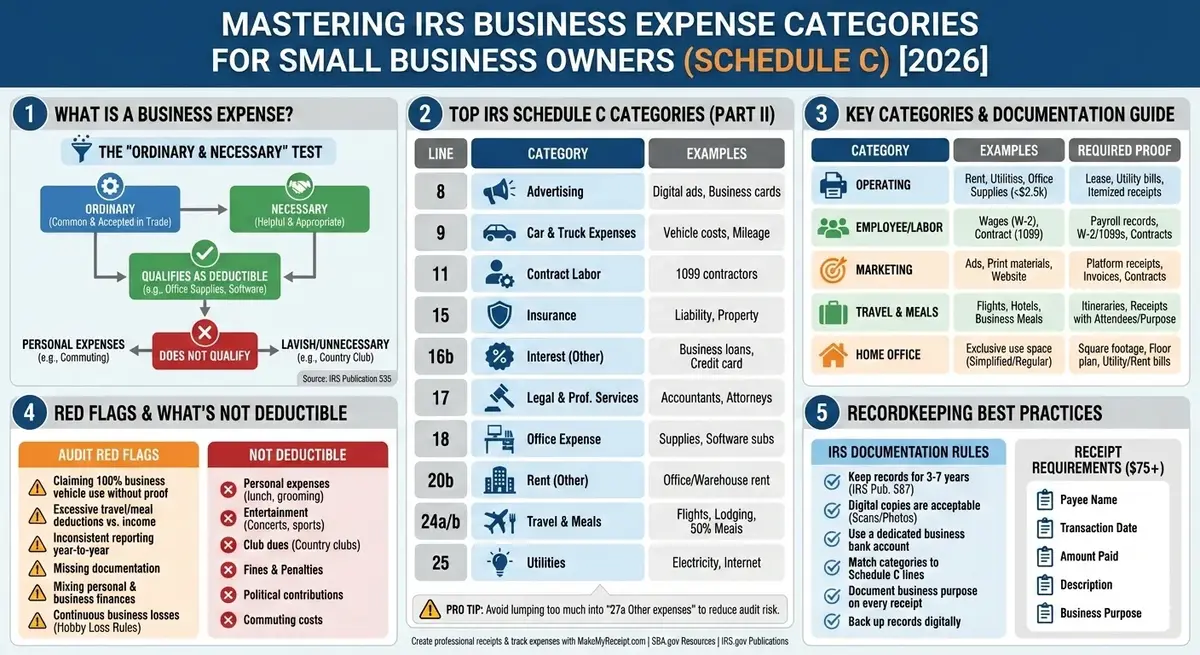
Before diving into specific categories, you need to understand what actually counts as a business expense. The IRS uses a simple two-part test called the "ordinary and necessary" standard.
The IRS "Ordinary and Necessary" Test
An expense is ordinary if it's common and accepted in your trade or industry. A graphic designer buying Adobe software is ordinary. That same designer buying a tractor is not.
An expense is necessary if it's helpful and appropriate for your business, even if it's not strictly required. Your business doesn't need a website to operate, but having one is helpful and appropriate, making it a necessary expense.
Both conditions must be met. A lavish vacation might feel necessary for your mental health, but it's neither ordinary nor necessary in the IRS's eyes.
Examples of what qualifies:
- Office supplies for your workspace
- Software subscriptions you use for work
- Professional development courses in your field
- Marketing and advertising costs
Examples of what doesn't qualify:
- Personal clothing (even if you only wear it to work)
- Commuting from home to your regular office
- Entertainment expenses (post-2017 tax reform)
- Country club memberships
The 20 Official IRS Expense Categories (Schedule C)
If you're self-employed or run a sole proprietorship, you report business expenses on Schedule C of your tax return. IRS data shows sole proprietors claimed over $580 billion in deductions in 2022 alone. The IRS organizes expenses into 20 specific line items in Part II of Schedule C, as detailed in IRS Publication 334.
Here's the complete breakdown:
| Line | Category | What Goes Here |
|---|---|---|
| 8 | Advertising | Digital ads, print materials, business cards |
| 9 | Car and truck expenses | Vehicle costs or standard mileage deduction |
| 10 | Commissions and fees | Payments to non-employee salespeople |
| 11 | Contract labor | Payments to independent contractors (1099) |
| 12 | Depletion | Natural resource extraction businesses only |
| 13 | Depreciation | Cost of equipment spread over useful life |
| 14 | Employee benefit programs | Health insurance, retirement contributions for employees |
| 15 | Insurance | Business liability, professional, property insurance |
| 16a | Interest (mortgage) | Mortgage interest on business property |
| 16b | Interest (other) | Business loans, credit card interest |
| 17 | Legal and professional services | Attorneys, accountants, consultants |
| 18 | Office expense | Supplies, postage, software subscriptions |
| 19 | Pension and profit-sharing | Employer contributions to employee retirement |
| 20a | Rent (vehicles, equipment) | Leased equipment and vehicles |
| 20b | Rent (other business property) | Office rent, warehouse space |
| 21 | Repairs and maintenance | Fixing and maintaining business property |
| 22 | Supplies | Materials consumed in your business |
| 23 | Taxes and licenses | Business licenses, permits, payroll taxes |
| 24a | Travel | Transportation, lodging, meals during business trips |
| 24b | Meals | Business meals (50% deductible) |
| 25 | Utilities | Electricity, water, internet, phone for business |
| 26 | Wages | Salary and wages paid to employees |
| 27a | Other expenses | Anything that doesn't fit above categories |
Common mistake to avoid: Don't lump everything into "Other expenses" (Line 27a). The more specific you are with categorization, the less likely the IRS will question your return.
Major Business Expense Categories Explained
Let's dig deeper into the most common expense categories and what documentation you need for each.
Operating Expenses
Operating expenses keep your business running day-to-day. These are typically your most frequent and predictable costs.
Rent and lease payments include your office space, retail location, warehouse, or coworking membership. Keep your lease agreement on file and save monthly rent receipts or bank statements showing payments.
Utilities cover electricity, water, natural gas, internet service, and business phone lines. If you work from home, only the business-use portion is deductible. Save utility bills and document your calculation method.
Office supplies and equipment range from paper and pens to computers and furniture. Items over $2,500 may need to be depreciated rather than expensed immediately. Keep all purchase receipts with itemized details.
Documentation needed:
- Lease agreements
- Monthly utility statements
- Itemized purchase receipts
- Bank or credit card statements
For tracking these expenses, an organized expense receipt template helps maintain consistent records throughout the year.
Employee and Labor Costs
Labor typically represents 40-70% of total business expenses, making accurate categorization essential.
Wages and salaries include regular pay, overtime, bonuses, and commissions to employees (W-2 workers). Keep payroll records, W-2 forms, and time tracking documentation.
Benefits and insurance cover employer-paid health insurance, retirement contributions, paid leave, and workers' compensation. Maintain benefit enrollment records and premium payment documentation.
Contract labor applies to independent contractors who receive 1099 forms. Keep contracts, invoices, and proof of payment. The IRS scrutinizes contractor classifications closely, so ensure your workers truly qualify as contractors rather than employees. Review the IRS guidelines on worker classification to avoid misclassification penalties.
Documentation needed:
- Payroll records and pay stubs
- W-2 and 1099 forms
- Benefit enrollment documents
- Contractor agreements and invoices
Marketing and Advertising
Everything you spend to attract customers falls into this category.
Digital advertising includes Google Ads, Facebook ads, sponsored content, and SEO services. Platform receipts and agency invoices serve as documentation.
Print materials cover business cards, brochures, flyers, signage, and direct mail. Keep invoices from print shops and design services.
Website costs include domain registration, hosting, design, and development. Annual receipts and contractor invoices provide documentation.
Documentation needed:
- Ad platform receipts
- Agency invoices
- Print shop receipts
- Web hosting statements
Travel, Meals, and Vehicle Expenses
This category gets the most IRS attention, so documentation matters more than ever.
Business travel includes flights, hotels, rental cars, and ground transportation for trips with a primary business purpose. With U.S. business travel spending exceeding $314 billion annually, proper documentation of these expenses is critical. Personal days added to a business trip aren't deductible. Keep boarding passes, hotel receipts, and rental agreements. For complete travel expense rules, see IRS Publication 463.
Meals are 50% deductible when you're traveling for business or meeting with clients, customers, or business contacts. Entertainment was eliminated as a deduction in 2017, but legitimate business meals still qualify.
For every business meal, document:
- Who attended
- Business relationship
- Business purpose discussed
- Date and location
- Amount spent
Vehicle expenses offer two options: the standard mileage rate (70 cents per mile in 2025) or actual expenses (gas, maintenance, insurance, depreciation). You must choose one method and stick with it for that vehicle. If you use rideshare services like Uber or Lyft for business, see our rideshare expense statistics for current cost benchmarks.
If using mileage, maintain a log with:
- Date of each trip
- Starting and ending location
- Business purpose
- Miles driven
If using actual expenses, keep receipts for gas, oil changes, repairs, insurance, and registration. In both cases, document the percentage of business vs. personal use. Commercial truckers operating across multiple states have additional fuel documentation requirements under the International Fuel Tax Agreement — see our IFTA fuel receipt requirements guide for compliance details.
Documentation needed:
- Travel itineraries and boarding passes
- Hotel and rental car receipts
- Meal receipts with notes on attendees and purpose
- Mileage logs or actual expense receipts
Professional Services
Expert help for your business falls into this deductible category.
Legal fees include contract review, trademark registration, business formation, and general legal counsel. Fees for personal matters (divorce, estate planning) are not deductible.
Accounting and tax preparation covers bookkeeping services, tax return preparation, and audit representation. Keep invoices from your accountant or tax preparer.
Consulting includes business consultants, marketing strategists, and industry experts you hire for advice. Maintain contracts and invoices. (Not sure when to use a receipt vs invoice? Our guide explains the difference.)
Documentation needed:
- Engagement letters
- Invoices with service descriptions
- Proof of payment
A service receipt template works well for documenting professional services you've received.
Insurance and Taxes
Business protection and compliance costs are generally deductible.
Business insurance covers general liability, professional liability (errors and omissions), property insurance, and product liability. Keep policy documents and premium payment records.
License fees and permits include business licenses, professional certifications, and regulatory permits. Save the actual licenses and renewal receipts.
Payroll taxes are deductible for the employer's portion of Social Security, Medicare, and unemployment taxes. Payroll reports document these expenses.
Documentation needed:
- Insurance policies and premium statements
- License and permit copies
- Payroll tax reports
Home Office Expenses
If you use part of your home regularly and exclusively for business, you can deduct home office expenses using one of two methods. The IRS provides detailed guidance in Publication 587: Business Use of Your Home.
Simplified vs. Regular Method
Simplified method: Deduct $5 per square foot of your home office, up to 300 square feet. Maximum deduction: $1,500. No need to track actual expenses, just maintain records of your office square footage.
Regular method: Calculate the actual percentage of your home used for business and deduct that percentage of mortgage interest or rent, utilities, insurance, repairs, and depreciation. More complex, but often yields a larger deduction.
The exclusive use requirement: Your home office must be used regularly and exclusively for business. A guest bedroom with a desk in the corner doesn't qualify. A dedicated room used only as your office does.
Documentation needed:
- Home office square footage measurements
- Floor plan showing dedicated space
- Utility bills (for regular method)
- Mortgage or rent statements (for regular method)
What's NOT Deductible
Knowing what doesn't qualify as a business expense is equally important. These common expenses trip up many business owners:
Personal expenses can never be deducted, even if they happen during work hours. Lunch for yourself, personal grooming, and daily coffee runs don't count.
Entertainment was eliminated as a business deduction by the Tax Cuts and Jobs Act of 2017. Tickets to concerts, sporting events, and golf outings are not deductible, even with clients.
Club dues and memberships for country clubs, golf clubs, and social organizations don't qualify. However, professional associations and chambers of commerce still count.
Fines and penalties for violating laws and regulations are never deductible. Parking tickets, speeding fines, and regulatory penalties are personal costs.
Political contributions and lobbying expenses provide no tax benefit.
Commuting costs between your home and regular workplace are personal expenses. However, traveling from your office to a client site or between work locations during the day is deductible.
The key rule: When an expense has both personal and business elements, you can only deduct the portion that's strictly business-related.
Receipt and Documentation Requirements
Proper documentation protects you during an audit. Here's what the IRS expects. For a deep dive into receipt rules, see our complete guide to IRS receipt requirements.
What the IRS Requires
The $75 rule: For expenses under $75, the IRS doesn't strictly require a receipt, but you still need some form of documentation (bank statement, credit card statement) showing the expense. For anything $75 or more, keep the actual receipt. See IRS recordkeeping requirements for complete details.
Required receipt elements:
- Payee name (who you paid)
- Transaction date
- Amount paid
- Description of goods or services
- Business purpose
Record retention: Keep all business records for at least 3 years from the date you filed your return. For property and depreciation records, keep documentation for 3 years after you dispose of the property. Many accountants recommend keeping records for 7 years to be safe. The IRS outlines specific retention periods in their record retention guidelines. For a longer breakdown by receipt type, see our how long to keep receipts guide.
Digital vs. paper: The IRS accepts digital copies of receipts. Scans and photos are fine, as long as the image is legible and includes all required information.
Documentation by Expense Type
| Category | Required Documentation |
|---|---|
| Travel | Receipts, itineraries, business purpose statement |
| Meals | Receipt with attendees listed, business purpose, relationship |
| Vehicle | Mileage log OR expense receipts plus usage percentage |
| Home Office | Square footage, exclusive use documentation, utility bills |
| Equipment | Purchase receipt, business purpose, depreciation schedule if applicable |
| Contract Labor | 1099 forms, contracts, invoices, payment records |
A cash receipt template can help document cash transactions that might otherwise lack proper records. For a complete walkthrough on cash documentation, see our guide on how to create a receipt for cash transactions. For detailed purchases, learn how to create an itemized receipt that meets IRS standards.
Common Mistakes That Trigger IRS Audits
Only about 0.2% of taxpayers earning under $1 million get audited, according to IRS audit statistics. But certain expense patterns raise red flags.
Expense Red Flags to Avoid
Claiming 100% business use of a vehicle almost never passes the smell test. Unless you have a dedicated work vehicle that never sees personal use, document the actual business percentage.
Excessive travel and meal deductions relative to your income draw attention. If you're claiming $30,000 in travel on $50,000 of revenue, expect questions.
Inconsistent reporting from year to year looks suspicious. If your advertising expense jumps from $1,000 to $20,000 with no corresponding revenue increase, auditors notice.
Missing documentation is the most common audit problem. The IRS shifts the burden of proof to you, so without receipts, you lose the deduction. If you've lost important receipts, see our guide on what to do when you lose a receipt.
Mixing personal and business expenses on a single account makes tracking difficult and suggests sloppy record-keeping.
Continuous business losses over multiple years suggest a hobby rather than a legitimate business. The IRS may reclassify your "business" and disallow all deductions under the hobby loss rules.
How Proper Documentation Protects You
Organized records are your best audit defense. Create a system where:
- Every expense has a receipt
- Receipts are categorized by expense type
- Business purpose is documented
- Records are backed up digitally
Using a sales receipt template for your own sales transactions creates a paper trail that supports both income and related expenses.
How to Set Up Your Expense Categories
A good categorization system makes tax time painless.
Getting Organized
Match your categories to Schedule C lines. When your expense categories align with IRS categories, transferring data to your tax return takes minutes instead of hours.
Use consistent naming. "Advertising," "Marketing," and "Ads" might all mean the same thing to you, but consistency prevents confusion and duplication.
Separate personal from business completely. Use a dedicated business bank account and credit card. Mixing accounts makes tracking difficult and looks unprofessional during audits.
Consider accounting software. Tools like QuickBooks, Wave, or FreshBooks automate categorization and generate reports that match Schedule C categories.
Know when to get help. If your business has employees, inventory, or complex transactions, working with a bookkeeper or accountant prevents costly mistakes. The cost of professional help is itself a deductible expense. The SBA's guide to managing business finances offers additional resources for getting organized.
Wrapping Up
Understanding business expense categories saves you money on taxes and stress during audit season. The fundamentals are straightforward: expenses must be ordinary and necessary, documentation is essential, and accurate categorization protects you.
Key takeaways:
- Use the IRS "ordinary and necessary" test to evaluate any expense
- Match your categories to Schedule C line items
- Document everything, especially travel, meals, and vehicle expenses
- Keep records for at least 3-7 years
- Separate personal and business finances completely
Proper documentation is just as important as the categorization itself. Every receipt you save and every mileage log you maintain builds your audit defense.
Ready to get your expense documentation organized? Create professional receipts for any business expense in minutes with MakeMyReceipt. Whether you need expense receipts, service documentation, or cash transaction records, you'll have professional records that stand up to any scrutiny.
Frequently Asked Questions
What are the main categories of business expenses? The IRS recognizes 20 official expense categories on Schedule C, including advertising, vehicle expenses, contract labor, insurance, office expenses, rent, supplies, travel, meals, utilities, and wages. Most business expenses fall into one of these categories.
What business expenses are 100% deductible? Most ordinary business expenses like rent, utilities, office supplies, advertising, and professional services are 100% deductible. Meals are 50% deductible. Some expenses like luxury vehicles and home offices have caps or special rules. See IRS Publication 535 for the complete list of deductible business expenses.
How do I categorize my business expenses? Match each expense to the appropriate Schedule C category based on its primary purpose. Use consistent naming in your accounting system, keep receipts for every expense, and document the business purpose. When in doubt, consult the IRS instructions for Schedule C or ask a tax professional.
How long should I keep receipts for business expenses? Keep business expense records for at least 3 years from when you filed the return. For property, equipment, and depreciation-related expenses, keep records until 3 years after you dispose of the asset. Many accountants recommend 7 years to be safe.
What's the difference between a business expense and a capital expense? Business expenses are fully deductible in the year you pay them. Capital expenses (like equipment over $2,500 or property improvements) must be depreciated over multiple years. The distinction affects when you get the tax benefit. Learn more about depreciation rules in IRS Publication 946.
What qualifies as a deductible business expense? An expense must be both ordinary (common in your industry) and necessary (helpful to your business) to qualify. It must also be directly related to your business operations and properly documented. Personal expenses, entertainment, and certain other categories are never deductible.
Ready to create your receipt?
Try our free receipt maker with customizable templates.
Open Receipt Builder