
IFTA Fuel Receipt Requirements: Complete Compliance Guide for 2025
Learn the 9 essential elements for IFTA fuel receipts, record retention rules, and how to avoid audit penalties. Complete compliance checklist for truckers.
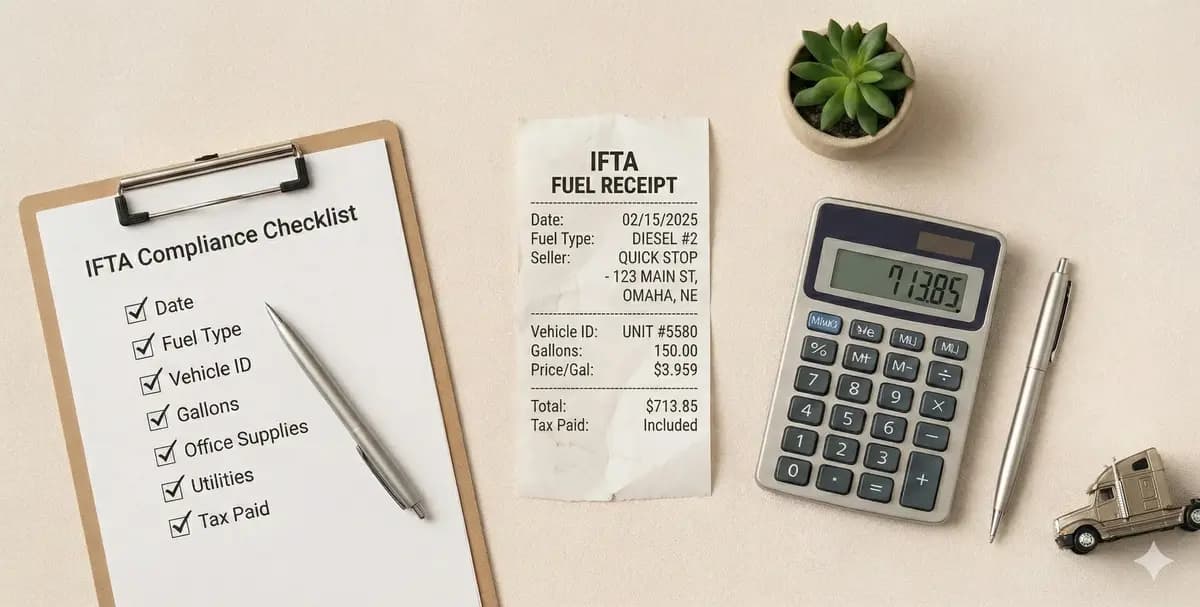
Picture this: an IFTA auditor shows up at your office requesting four years of fuel receipts. You dig through boxes, folders, and glove compartments only to realize half your receipts are faded beyond recognition and the other half are missing critical information. This scenario plays out for thousands of trucking operators every year, often resulting in penalties, reduced fuel tax credits, and serious headaches.
For the 3.54 million truck drivers operating across the United States, proper fuel receipt documentation is not optional. The International Fuel Tax Agreement requires specific information on every fuel purchase, and understanding these IFTA fuel receipt requirements can mean the difference between maximum tax credits and costly audit penalties.
This guide breaks down exactly what must be on your IFTA fuel receipts, how long to keep them, and how to organize your documentation for audit-ready compliance.
What is IFTA and why do fuel receipts matter?
The International Fuel Tax Agreement is a cooperative agreement among 48 US states and 10 Canadian provinces. It simplifies fuel tax reporting for motor carriers operating across multiple jurisdictions. Instead of filing separate fuel tax returns in every state where you purchase fuel or travel, IFTA allows you to file a single quarterly return with your base jurisdiction.
Here is how it works: you pay fuel tax when you fill up at the pump. IFTA then redistributes that tax to the states where you actually burned the fuel based on your mileage. If you traveled more miles in a state than the fuel purchases there would cover, you owe that state additional tax. If you purchased more fuel than you burned, you get a credit.
Your fuel receipts are the proof of tax-paid gallons. Without proper documentation, you cannot claim those credits. Missing or inadequate receipts during an audit can result in your miles per gallon being reduced to 4.0 or by 20%, whichever costs you more.
Who must comply? Any qualified motor vehicle operating in two or more IFTA jurisdictions. A qualified vehicle has two axles and weighs over 26,000 pounds, has three or more axles regardless of weight, or is used in combination when the combined weight exceeds 26,000 pounds.
The 9 elements every IFTA fuel receipt should include
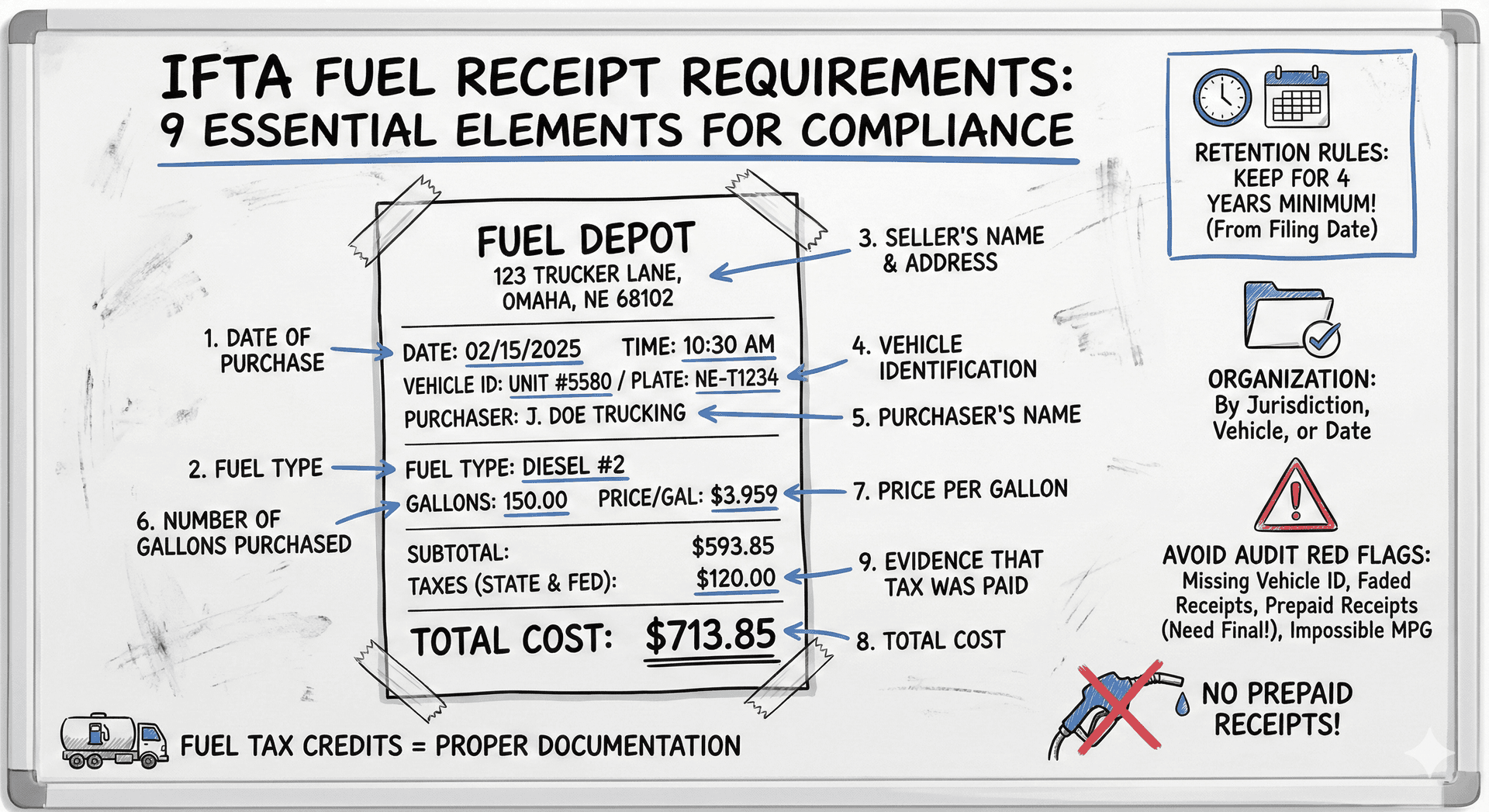
IFTA guidelines specify seven to eight core elements that must appear on every fuel receipt, though the exact list varies slightly by jurisdiction. To ensure your receipts pass muster in any state or province, capture all nine elements below. This comprehensive approach covers every requirement you might encounter and keeps your documentation audit-proof.
1. Date of purchase
The exact date you purchased fuel. This ties the purchase to a specific quarter for reporting purposes and helps verify the receipt against your trip records.
2. Fuel type
Specify whether the fuel is diesel, gasoline, propane, liquefied natural gas, compressed natural gas, or another fuel type. Different fuel types may have different tax rates, and mixing them up can create reporting errors.
3. Seller's name and address
The complete name and physical address of the fuel vendor. This must include the city and state or province. A receipt that only shows "Quick Stop" without a full address does not meet IFTA requirements.
4. Vehicle identification
Your unit number or license plate number must appear on the receipt. This is one of the most commonly missing elements. Always verify the pump attendant or your driver enters this information at the time of purchase.
5. Purchaser's name
Your name or your company's name. The receipt must clearly identify who purchased the fuel. Generic receipts without purchaser information are not compliant.
6. Number of gallons purchased
The total volume of fuel purchased. This is the number that determines your tax-paid gallons for that jurisdiction.
7. Price per gallon
The unit price for the fuel. This helps verify the math on the receipt and provides documentation for expense tracking.
8. Total cost
The complete purchase amount. This should match the gallons multiplied by the price per gallon, plus any applicable taxes.
9. Evidence that tax was paid
The receipt must show that fuel tax was included in the purchase price or paid separately. Most retail fuel purchases in the US include tax in the pump price. Look for language indicating the tax is included, or a separate line showing state fuel tax.
Example: IFTA-Compliant Fuel Receipt
Here's what a proper IFTA fuel receipt looks like with all nine required elements:
FLYING J TRAVEL CENTER #847
8901 Interstate Highway 35
Denton, TX 76207
(940) 555-0192

Date: 01/15/2025          Time: 14:32
Transaction #: 847291

DIESEL FUEL PURCHASE
────────────────────────────────────
Pump #: 12
Gallons:                     187.4
Price per Gallon:           $3.459
────────────────────────────────────
Fuel Subtotal:             $648.08
State Fuel Tax Included:    $37.48
Federal Tax Included:       $45.70

TOTAL:                     $648.08

Payment: Fleet Card ****7234
Auth Code: 928471

────────────────────────────────────
Unit #: 2847
Driver: M. Johnson
Company: ABC Trucking LLC
────────────────────────────────────

TAX INCLUDED IN PRICE
Thank you for choosing Flying J!
This receipt includes all nine elements: date (01/15/2025), fuel type (diesel), seller name and full address (Flying J, Denton, TX 76207), vehicle identification (Unit #2847), purchaser name (ABC Trucking LLC), gallons (187.4), price per gallon ($3.459), total cost ($648.08), and evidence of tax paid (state and federal tax lines).
What types of fuel documentation are acceptable?
Understanding IFTA documentation requirements helps you choose the right system for your operation. IFTA allows several forms of acceptable fuel documentation beyond standard receipts from the pump.
Original receipts are the gold standard. These are the paper receipts you receive at the time of purchase from the fuel vendor.
Credit card receipts are acceptable when they contain all nine required elements. Many credit card receipts from fuel purchases include this information automatically.
Automated vendor-generated invoices work well for fleet accounts. These are the monthly statements from fuel card companies that itemize each transaction with all required details.
Transaction listings from third parties such as fuel card providers are valid as long as they include all required information for each purchase. Many carriers use these records as their primary fuel receipt for IFTA reporting.
Electronic and digital records are fully acceptable. As payment methods continue to evolve, ensuring your fuel documentation captures the required data regardless of payment type is essential. You can maintain scanned copies of receipts or records in your fuel card system instead of paper originals. Using a consistent IFTA fuel receipt template for manual entries ensures you capture all required data.
Photocopies are acceptable during audits if they are legible and contain all required information.
Not acceptable: Prepaid fuel receipts do not satisfy IFTA requirements. If you prepay for fuel, you must return to get the actual receipt showing the gallons pumped after the transaction completes.
Common fuel receipt mistakes that trigger IFTA audits
Understanding what triggers an audit helps you avoid common pitfalls. IFTA requires each jurisdiction to audit at least 3% of licensees annually, and auditors know exactly what problems to look for.
Example: Non-Compliant Fuel Receipt
Compare this problematic receipt to the compliant example above:
QUICK STOP
Fuel Purchase

01/15/25

Diesel - $648.08

Visa ****7234

Thank you!
What's wrong with this receipt:
- Missing seller's full address (no city, state, or street)
- No vehicle identification (unit number or plate)
- No purchaser/company name
- No gallons purchased
- No price per gallon
- No evidence of tax paid
This receipt would be rejected during an IFTA audit, potentially costing you the full fuel tax credit for this purchase.
Using prepaid receipts without actual fuel documentation. Paying at the counter before pumping is common, but you must get the final receipt showing actual gallons pumped. Prepaid slips showing dollar amounts only are not valid.
Missing vehicle identification. This is the most frequently missing element. Train your drivers to always enter the unit number before starting the pump or to write it on the receipt immediately.
Faded or illegible receipts with no backup. Thermal paper receipts fade over time. If you cannot read the information, neither can an auditor. Create digital copies promptly or request duplicate receipts from vendors.
Receipts without state or jurisdiction information. The seller's full address including state is required. Partial addresses do not work.
Impossible MPG calculations. If your reported fuel purchases do not match reasonable miles per gallon for your vehicle type, auditors will scrutinize your receipts closely. The average for semi trucks is 6-8 MPG. Anything above 10 or below 4 raises red flags.
Bulk fuel without proper disbursement records. If you purchase fuel in bulk and store it at your facility, you need delivery receipts, quarterly inventory reconciliations, and records showing how much fuel went into each vehicle.
How long to keep IFTA fuel receipts
IFTA requires you to retain fuel records for a minimum of four years from the due date of the quarterly return or the filing date, whichever is later.
Here is how to calculate your retention period: if your Q1 2025 return is due April 30, 2025, and you file it on April 25, 2025, you must keep records until at least April 30, 2029. If you file late on May 15, 2025, your retention period extends to May 15, 2029.
Acceptable storage methods include:
- Paper originals in organized files
- Microfilm or microfiche copies
- Digital scans stored on computer systems
- Cloud-based storage solutions
- Fuel card provider records
The key is that records must be accessible for audit within 30 days of a request. Keep your storage system organized so you can produce four years of documentation quickly if needed.
Bulk fuel documentation requirements
Operators who purchase fuel in bulk quantities and store it at their facilities face additional documentation requirements.
Delivery receipts must accompany every bulk fuel delivery. These should include the date, vendor information, gallons delivered, and which tank received the fuel.
Quarterly inventory reconciliation records show beginning inventory, fuel added, fuel withdrawn, and ending inventory. The math must balance within acceptable variance.
Tank capacity documentation proves your storage capability matches your reported inventory levels.
Disbursement records by vehicle track which truck received fuel from your bulk tank and how many gallons. Without these records, you cannot allocate fuel to specific vehicles for IFTA reporting.
Example: Bulk Fuel Delivery Receipt
MIDWEST PETROLEUM DISTRIBUTORS
4521 Industrial Parkway
Kansas City, MO 64129
(816) 555-0147

BULK FUEL DELIVERY RECEIPT
────────────────────────────────────
Delivery Date: 01/20/2025
Delivery Time: 08:45 AM
Invoice #: MPD-2025-00847

DELIVERED TO:
ABC Trucking LLC
1200 Commerce Drive
Kansas City, MO 64108
Tank Location: Yard Tank #1

PRODUCT DELIVERED:
────────────────────────────────────
Ultra Low Sulfur Diesel #2
Opening Meter:           847,291
Closing Meter:           850,291
Gallons Delivered:         3,000

Price per Gallon:         $3.289
Fuel Subtotal:         $9,867.00
MO State Tax (@ $0.195):  $585.00
Federal Tax (@ $0.244):   $732.00
────────────────────────────────────
TOTAL:                 $9,867.00
(State & Federal Tax Included)

Driver: J. Williams
Truck #: MPD-284
BOL #: 847291-KC

Received By: ________________
Print Name: ________________
Date: ________________
Example: Bulk Fuel Disbursement Log
For each withdrawal from your bulk tank, maintain records like this:
ABC TRUCKING LLC - BULK FUEL DISBURSEMENT LOG
Tank: Yard Tank #1 | Month: January 2025

Date     | Unit # | Driver      | Gallons | Meter Reading
---------|--------|-------------|---------|---------------
01/20    | 2847   | M. Johnson  | 187     | 3,000
01/20    | 2851   | R. Smith    | 195     | 2,813
01/21    | 2847   | M. Johnson  | 142     | 2,618
01/21    | 2849   | T. Davis    | 201     | 2,476
01/22    | 2853   | K. Wilson   | 178     | 2,275
...

Beginning Inventory (01/01):    1,247 gal
+ Deliveries:                   3,000 gal
- Disbursements:               (2,903 gal)
= Ending Inventory (01/31):     1,344 gal
Bulk fuel operations are scrutinized closely during audits. The additional recordkeeping burden often leads operators to use retail fueling instead, which provides automatic documentation through receipts.
What happens when fuel receipts are missing or lost?
Receipts get lost, damaged, or destroyed. Knowing how to handle missing documentation can minimize the damage during an audit.
Take immediate steps when you discover missing receipts:
Contact the fuel vendor to request duplicate receipts. Many vendors can reprint receipts from their systems, especially for credit or fleet card transactions. Act quickly because vendors may only retain transaction data for a limited time.
Pull fuel card statements as backup documentation. Most fuel card providers maintain detailed transaction records that include all required IFTA elements. These reports often serve as acceptable substitutes for original receipts.
Check your credit card statements. While these may not include all nine elements, they provide supporting evidence of the transaction.
Audit implications of missing receipts:
When auditors encounter missing documentation, they may reduce your miles per gallon to 4.0 or by 20%, whichever results in a higher tax assessment. This penalty recalculates your fuel usage across all jurisdictions, typically resulting in significant additional tax owed to states where you traveled but did not purchase fuel.
For example, if your actual fleet MPG is 6.5 and auditors reduce it to 4.0, your calculated fuel consumption increases by 62.5%. You would owe additional tax on those phantom gallons.
Create backup documentation promptly. When original receipts are lost or illegible, having organized expense receipt records and supporting documentation can help demonstrate the legitimacy of your fuel purchases.
IFTA fuel receipt checklist: verify before you file
This checklist covers all IFTA receipt requirements to verify every fuel receipt before including it in your quarterly filing. This format helps you catch missing information before it becomes an audit problem.
For each fuel receipt, confirm:
- Date of purchase is present and legible
- Fuel type (diesel, gasoline, etc.) is specified
- Seller name is complete (not abbreviated)
- Seller address includes city and state
- Your vehicle unit number or plate number appears
- Your name or company name is on the receipt
- Gallons purchased is clearly shown
- Price per gallon is visible
- Total purchase amount is correct
- State where fuel was purchased is identifiable
- Tax-paid indication is present
Red flags to watch for:
- Thermal paper that has started fading
- Handwritten receipts without all elements
- Prepaid amounts without final gallons
- Out-of-state purchases without full address
- Bulk fuel without disbursement records
When you spot problems, address them immediately. Request duplicates, create digital backups, or document the issue in your files.
How to organize fuel receipts for quarterly filing
A good organization system makes quarterly filing faster and audit preparation manageable. Here are proven approaches:
Organize by jurisdiction. Create separate folders for each state or province where you purchase fuel. At filing time, you can quickly total gallons and tax paid by jurisdiction.
Organize by vehicle. If you operate multiple trucks, maintaining separate records for each unit simplifies per-vehicle reporting and helps identify vehicles with unusual fuel consumption.
Organize by date. A chronological system makes it easy to pull records for a specific quarter and provides a clear timeline for auditors.
Go digital. Scan or photograph receipts weekly. Paper fades, gets damaged, or disappears. Digital copies stored in cloud systems are searchable, shareable, and protected from physical damage.
Use fuel cards. Fuel card programs provide automatic documentation. Your monthly statement becomes a comprehensive record of all purchases with required IFTA elements already captured. This reduces manual recordkeeping significantly.
Create receipt templates for cash purchases. For the occasional cash receipt fuel purchase, having a consistent format for recording transaction details helps ensure nothing gets missed.
Maintain an itemized receipt system for tracking all fuel-related expenses together, making quarterly reconciliation more straightforward.
2025 IFTA filing deadlines
Mark these quarterly filing deadlines on your calendar:
- Q1 (January - March 2025): Due April 30, 2025
- Q2 (April - June 2025): Due July 31, 2025
- Q3 (July - September 2025): Due October 31, 2025
- Q4 (October - December 2025): Due January 31, 2026
Late filing penalties start at $50 or 10% of your net tax liability, whichever is greater. Beyond financial penalties, late or missed filings can result in license suspension.
Conclusion
Proper fuel receipt documentation is not bureaucratic busywork. It directly affects how much you pay or receive back in fuel taxes across all the jurisdictions where you operate. The key elements, four-year retention period, and organization best practices outlined in this guide protect you during audits and ensure you claim every tax credit you deserve.
The key takeaways:
- Every receipt needs all key elements to be IFTA compliant
- Keep records for four years minimum from the filing date
- Digital backups protect against faded or lost paper receipts
- Missing documentation can reduce your MPG to 4.0, increasing tax liability significantly
- Organization by jurisdiction, vehicle, or date makes filing and audits manageable
When you need to create professional fuel documentation, browse receipt templates that include all the fields required for proper recordkeeping. You can create your fuel receipt with the right format and information in minutes.
Stay compliant, keep your receipts organized, and protect your fuel tax credits.
Disclaimer: This article provides general information about IFTA fuel receipt requirements. MakeMyReceipt templates are designed for legitimate business documentation, backup records when originals are lost, and training purposes. Always consult with a qualified tax professional or your base jurisdiction for specific compliance questions. Do not use receipt generators to create fraudulent documentation.
Frequently Asked Questions
What are the IFTA fuel receipt requirements? IFTA fuel receipts must include nine key elements: date of purchase, fuel type, seller's name and address, vehicle identification (unit number or plate), purchaser's name, gallons purchased, price per gallon, total cost, and evidence that tax was paid. Missing any of these elements can result in disallowed fuel tax credits during an audit.
How long do I need to keep IFTA fuel receipts? You must retain IFTA fuel records for a minimum of four years from the due date of the quarterly return or the filing date, whichever is later. Records must be accessible within 30 days of an audit request.
What happens if I lose my IFTA fuel receipts? Missing documentation during an audit can result in your miles per gallon being reduced to 4.0 or by 20%, whichever costs you more. Contact fuel vendors for duplicate receipts, pull fuel card statements as backup, and check credit card statements for supporting evidence.
Are digital copies of fuel receipts acceptable for IFTA? Yes, IFTA accepts electronic and digital records including scanned copies of receipts and fuel card system records. Digital copies must be legible and contain all required information.
What is not acceptable as IFTA fuel documentation? Prepaid fuel receipts do not satisfy IFTA requirements. You must get the actual receipt showing gallons pumped after completing the transaction. Receipts missing required elements like vehicle identification or seller's full address are also not compliant.
How often are IFTA licensees audited? IFTA requires each jurisdiction to audit at least 3% of licensees annually. Auditors look for common problems like missing vehicle identification, faded receipts, impossible MPG calculations, and bulk fuel without proper disbursement records.
Ready to create your receipt?
Try our free receipt maker with customizable templates.
Open Receipt Builder