
Kroger Receipt Codes: SC, MC, the Letters, and Whether You Really Saved
What SC, MC, F, B, and T mean on a Kroger receipt, how fuel points and digital coupons print, and why the savings summary deserves a second look.
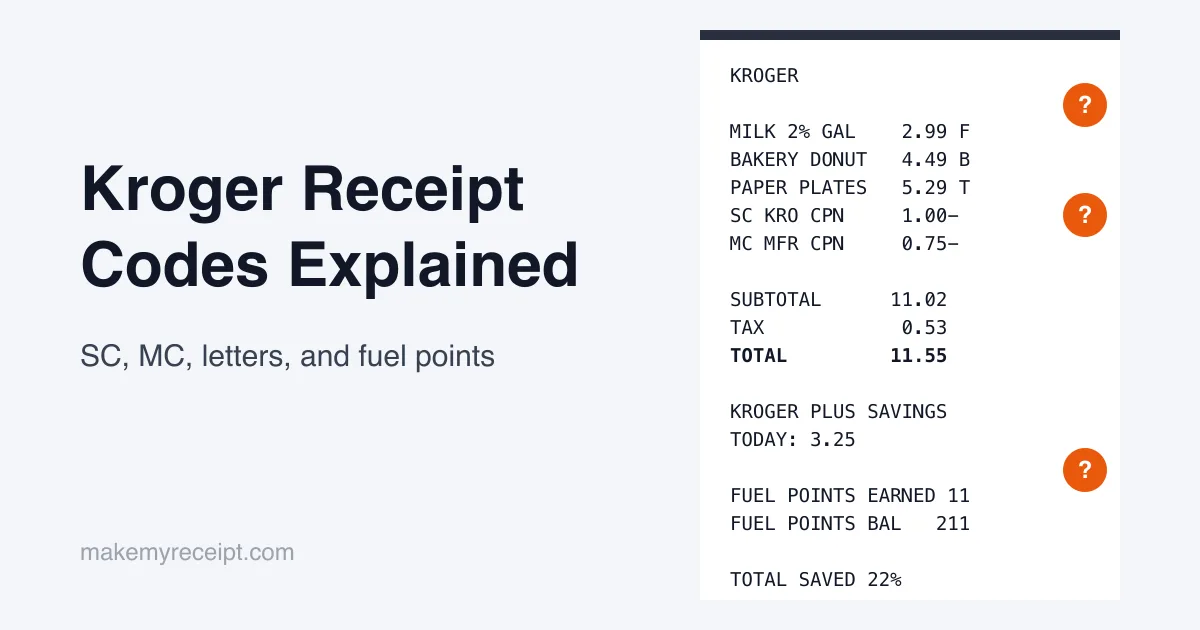
A Kroger receipt is unusually eager to tell you how well you did. Card savings, coupon deductions, a total savings line, fuel points earned: the bottom third of the slip is a scorecard. This guide decodes all of it, and then asks the question the scorecard skips: did every item actually ring up at the price on the shelf? In 2025, secret shoppers found that at Kroger-owned stores, the answer was too often no. That makes reading this particular receipt less about curiosity and more about checking the math.
As always in this series, Kroger publishes no official key to its codes, so we label what is documented, what is reported, and what is folklore. The cross-chain anatomy lives in our guide on how to read a receipt.
The Codes at a Glance
| Code | Reported meaning | How solid? |
|---|---|---|
| SC | Scanned (store) coupon | Commonly reported |
| MC | Manufacturer coupon | Commonly reported |
| F | SNAP-eligible food | Per FSA administrators, not Kroger |
| B | SNAP-eligible but taxed; some report bakery/prepared | Disputed |
| T | Taxable item | Per FSA administrators, not Kroger |
| FX | FSA/HSA-eligible item | Per FSA administrators |
| Negative line under an item | Digital coupon deduction | Confirmed by couponing guides |
| Fuel points lines | Points earned + running balance | Official program, prints per Kroger's FAQ |
| Total savings | Card + coupon discounts vs regular price | Kroger's own framing |
SC, MC, and the Digital Coupon Lines
The coupon codes are the easy ones. SC is commonly read as a scanned store coupon, Kroger's own discount, and MC as a manufacturer coupon that the brand reimburses. Same convention most grocers use, and our receipt abbreviations glossary covers the family of coupon codes across chains.
Digital coupons behave visibly on the receipt: when one applies, the deduction prints directly below the qualifying item rather than pooled at the bottom. That placement is useful. It means you can scan down the receipt and see exactly which clipped coupons actually fired, which matters because coupons failing to apply at the register is one of the most common Kroger shopper complaints. Most digital coupons are limited to one per account, and a digital and paper coupon cannot combine on the same item.
The Letters: F, B, T, and the FX Flag
The letter codes come with an unusual twist: the best documentation is from FSA plan administrators, not from Kroger. PeopleKeep's guide to medical receipt codes reports that at Kroger banners, F marks SNAP-eligible food, B marks items that are SNAP-eligible but taxed, and T marks taxable items, with FX as the separate flag for FSA and HSA eligible products.
Two honest caveats. First, some shoppers instead read B as bakery or deli, since prepared foods are taxed differently from groceries in many states; both readings point at the same underlying fact, that B items carry tax where plain food does not, so the dispute matters less than it looks. Second, all of these letters are register configuration that varies by state and Kroger division, because what counts as taxed food is state law, not company policy.
One collision worth knowing if you shop across chains: at Kroger, F is about SNAP food. At CVS, F flags FSA-eligible health items, a completely different program. Same letter, different meaning, two miles apart, which is the entire reason no universal receipt-code table can exist.
The Savings Summary, Read Critically
The bottom of the receipt totals your trip: card savings, coupon savings, and often a percentage saved. The arithmetic on that line is fine. The question worth asking is upstream of it: did each item ring up at the shelf price you saw?
In May 2025, an investigation by Consumer Reports with the Guardian and the Food & Environment Reporting Network sent secret shoppers into 26 Kroger-owned stores across 14 states and Washington, D.C., including Harris Teeter, Fred Meyer, Fry's, and Ralphs. They documented more than 150 items with expired sale tags, charging an average of $1.70 more than the posted price, an 18.4% markup on those items. One example: tortillas tagged $2.99 rang up at $4.99. Kroger disputed the framing, calling widespread pricing concerns "patently false" and describing the findings as "a few dozen examples across several years out of billions of customer transactions." A US senator urged the company to fix the tags and reimburse customers, and class actions over sale-price accuracy are ongoing in several states.
Whoever you believe, the practical takeaway is the same and it costs you thirty seconds: keep the receipt, glance at the items you bought on sale, and compare against the tags you remember. If something rang up high, Kroger's posted return policy gives you 30 days at any Kroger-family store, with refunds to the original payment when you have the receipt. Pricing corrections are typically handled at the service desk on the spot. For context on what grocery trips cost in the first place, our grocery spending statistics report has the national numbers.
The Fuel Points Block
The other scorecard on the receipt is fuel points, and this one is officially documented. Per Kroger's fuel program FAQ, you earn 1 point per dollar on groceries, and the receipt shows the points earned in that transaction with your running balance printed near the bottom. Points redeem at Kroger fuel centers in 100-point increments, up to 1,000 points for $1.00 off per gallon on a single fill-up of up to 35 gallons; at participating Shell stations, redemption is capped at 10 cents per gallon per 100 points.
The details that catch people: gift card purchases earn double points, promotions can push multipliers higher, eligible prescriptions earn 25 points, fuel-center purchases themselves earn nothing, and points expire at the end of the month after the month you earned them. That last one is the expensive surprise, and the receipt's balance line is the easiest place to notice points about to lapse.
Identifiers and the Survey Code
Above the scorecard, the identifier block prints the standard register fields: store number, terminal, operator, transaction number, date and time. Those six values uniquely locate your purchase, which is exactly why Kroger's survey accepts them as an alternative to the printed entry ID. The receipt's survey invitation points to Kroger's feedback site, and completing it is widely reported to add 50 fuel points to your card, though we could not find an official rules page confirming the amount, so treat the figure as unconfirmed. As with any receipt survey, type the printed address yourself rather than trusting lookalike sites that rank for the search.
Frequently Asked Questions
What does SC mean on a Kroger receipt?
SC is commonly read as a scanned store coupon, the negative line a Kroger coupon produces, while MC marks a manufacturer coupon. The distinction matters to Kroger's accounting, since manufacturers reimburse their own coupons. To you, both are discounts, and the giveaway is the negative amount on the line.
What do F, B, and T mean on a Kroger receipt?
According to FSA plan administrators, F marks SNAP-eligible food, B marks items that are SNAP-eligible but taxed, and T marks taxable items. Kroger publishes no official key, and some shoppers report B on bakery or prepared items, which are taxed differently in many states. The letters vary by state and Kroger division, so treat them as local register settings.
How do fuel points show on a Kroger receipt?
The receipt shows the points earned in that transaction, and your running balance prints near the bottom. The standard rate is 1 point per dollar on groceries, with 2 points per dollar on gift cards and periodic promotional multipliers. Points redeem in 100-point steps, up to 1,000 points for a dollar off per gallon on a single fill of up to 35 gallons, and they expire at the end of the month after you earn them.
Is Kroger's total savings line accurate?
It accurately totals your card and coupon discounts against Kroger's regular prices. What it cannot tell you is whether each item rang up at its shelf price. A 2025 Consumer Reports investigation found expired sale tags at Kroger-owned stores overcharging an average of $1.70 per flagged item, so the smarter habit is comparing your receipt against the shelf tags, not admiring the savings percentage.
What happens if an item rings up higher than the shelf price at Kroger?
Take the receipt to the service desk. Kroger's posted return policy allows returns within 30 days at any Kroger-family store, and pricing errors are typically corrected on the spot with a refund of the difference. Keeping the receipt until you have checked the prices you expected is the whole game.
Does the Kroger receipt survey really give fuel points?
Kroger's receipts print an entry ID for its customer survey at kroger.com/feedback, and a 50-fuel-point reward for completing it is widely reported. We could not find an official Kroger rules page confirming the amount, so treat the exact reward as unconfirmed. The survey itself is real, and the printed receipt is the trustworthy pointer to it.
The Bottom Line
Read a Kroger receipt in two passes. First the codes: SC and MC for coupons, the F, B, and T letters as state-dependent SNAP and tax flags, digital deductions printed under their items, fuel points at the bottom. Then the audit: compare what rang up against what the shelf promised, because the investigation record says the gap is real often enough to check. The receipt is the only document that catches it. To see how the full format fits together, our Kroger receipt template rebuilds it line by line, and the receipt-reading guide covers the two minute verification method that works at any chain.
Ready to create your receipt?
Try our free receipt maker with customizable templates.
Open Receipt Builder