
Why Are CVS Receipts So Long? The Codes and Coupons Explained
Why CVS receipts run four feet long, what the F flag and ExtraBucks blocks mean, and how the receipt became CVS's favorite advertising channel.
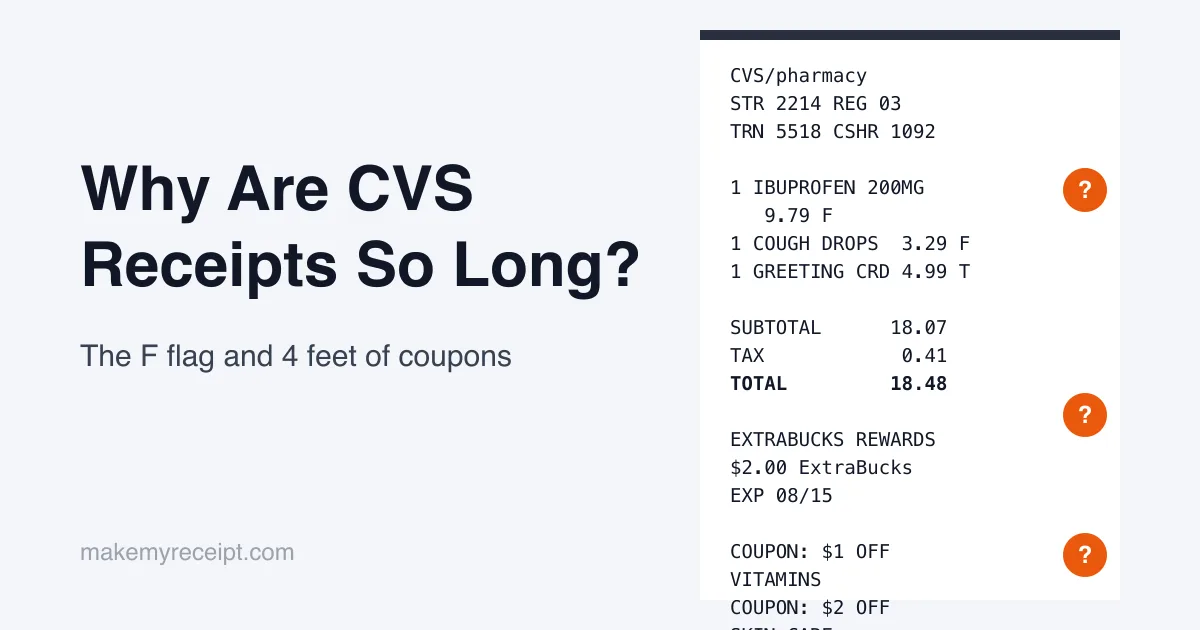
The CVS receipt is the only receipt in America with its own Halloween costume. In 2016, a man named John Baker wore a 12-foot replica to his local store, modeled on a real receipt he got buying a single pack of Tic Tacs. The joke works because everyone has held one. But the length is not a printing glitch or bureaucratic bloat. It is a deliberate marketing machine, and once you see how it works, every code on the tape makes sense.
This guide explains the CVS receipt from that first principle: the paper is an ad channel that happens to record your purchase. It is part of our series decoding retailer receipts; the general anatomy lives in our guide on how to read a receipt.
The Numbers Behind the Meme
The length has been measured, informally but repeatedly. A comparison summarized by the Advisory Board, drawing on reporting from Vox and the Boston Globe, found that scanning an ExtraCare card produced receipts over four feet long, while the same kind of purchase without a loyalty card printed about ten and a half inches. One shopper buying ibuprofen, cough drops, and NyQuil walked out with a receipt just short of six feet. Anecdotes of five and six footers circulate every year, and no official record exists because CVS does not keep one.
The gap between those two numbers, four feet versus ten inches, is the entire explanation. The purchase record is short. Everything else is printed marketing.
Why CVS Prints Ads on Your Receipt
When the cashier scans an ExtraCare card, the register does two jobs at once. It rings up the sale, and it pulls personalized offers for that specific account: coupons matched to what you buy, promotional deals, and any ExtraBucks Rewards you have earned. All of it prints inline on the receipt tape. Each printed coupon is reported to add around three and a half inches, so a member with a few active offers gets a receipt that unrolls like a scroll.
From CVS's side, this is cheap and effective advertising. The ExtraCare program dates to 2001, and the company has said the receipt offers replaced mass-mailed weekly circulars with individually targeted ones, using less paper than direct mail. The offers also work: after public pressure pushed CVS to pledge a 25% shorter receipt in 2013, a spokesperson noted coupon redemption rates hit all-time highs anyway.
By 2016 CVS leaned into the joke, announcing digital receipts on Jimmy Kimmel Live and rolling them out to 7,900 stores. In the announcement, the company framed it plainly: customers loved the coupons but wanted a paperless option. CVS later said digital receipts had saved more than 3 billion inches of paper.
The F Flag: The One Code Worth Knowing
Among the codes on a CVS receipt, one has real money attached. According to FSA plan administrators, an F printed beside an item marks it as FSA and HSA eligible, meaning it qualifies as a medical expense you can pay with pre-tax health account funds. The flag prints regardless of how you pay, so a receipt from a regular debit card still shows you which items you could have claimed.
There is real machinery behind that little letter. The IRS authorized point-of-sale substantiation in 2006, and an industry nonprofit called SIGIS maintains the master list of eligible products that registers check against. The register keeps a separate running total of eligible items, which is how an FSA debit card knows to pay for the bandages but not the batteries. CVS rolled out eligibility marking on receipts nationwide in early 2008, among the first large chains to do so.
The letter itself is chain dialect, not a standard. The same eligibility flag prints as H at Walmart, Rite Aid, and Sam's Club, FX at Kroger's stores, a + at Target, and a spelled-out FSA prefix at Walgreens, which also totals the eligible amount at the bottom. If you use these flags to document medical spending, our guide to IRS receipt requirements covers what records actually hold up.
Reading the ExtraBucks Blocks
The coupon-style blocks at the bottom of the tape are ExtraBucks Rewards, the ExtraCare program's currency. They come from a few sources: 2% back on qualifying purchases, weekly promotional deals, and pharmacy rewards. Each block prints with its own value and expiration date; in-store rewards expire at 11:59 PM local time on the printed date, and expired ones cannot be reissued. They spend like money on most of the store, with the usual exclusions (alcohol, gift cards, lottery, stamps, prescriptions, tobacco).
Two practical notes. First, the paper block is not the only copy: rewards also live in the CVS app, so a lost receipt does not mean lost ExtraBucks. Second, because purchases are tied to your ExtraCare account, a store can typically find your transaction for a return even when the paper has vanished into a jacket pocket.
The Rest of the Tape
Above the marketing, a CVS receipt is a normal receipt. The header block carries the usual identifiers: register number (REG), transaction number (TRN), cashier ID (CSHR), and store number (STR), plus date and time. Those fields, along with every abbreviation in the payment block, are covered in our receipt abbreviations glossary. Receipts also print an invitation to CVS's customer survey with an ID code tied to your transaction.
The paper itself has a quiet story. After campaigning by Green America, CVS switched its roughly 10,000 stores to phenol-free, recyclable receipt paper, dropping the BPS coating found in most US thermal receipts. Given how much tape CVS prints, that is one of the larger receipt-paper changes any retailer has made.
How to Shorten Yours
If you want the deals without the scroll, opt into digital receipts. Enrollment is through the CVS app (the ExtraCare or communication preferences menus, which move around as the app updates) or by asking a cashier to link your ExtraCare account to an email address. Offers and ExtraBucks then land in the app, and paper stays available on request. Mental Floss confirmed the cashier route works if the app menu defeats you.
Frequently Asked Questions
Why are CVS receipts so long?
Because the receipt doubles as CVS's advertising channel. When an ExtraCare card is scanned, the register prints personalized coupons, offers, and ExtraBucks Rewards directly onto the receipt tape. One comparison found receipts over four feet long with a card scanned versus about ten and a half inches without one. The purchase itself is a small fraction of the paper.
What does F mean on a CVS receipt?
F is CVS's flag for FSA and HSA eligible items, according to FSA plan administrators. It marks products that qualify as medical expenses under the IRS-approved point-of-sale system, and it prints no matter how you pay. Other chains use different marks for the same thing: Walmart and Rite Aid print H, Kroger stores print FX, and Walgreens prints an FSA prefix.
What are ExtraBucks Rewards on my receipt?
ExtraBucks Rewards are CVS's loyalty currency, earned through 2% back on qualifying purchases, promotional deals, and pharmacy rewards. They print as coupon-style blocks on your receipt or at the in-store coupon center, and also appear in the CVS app. Each reward carries its own expiration date, and in-store coupons expire at 11:59 PM local time on that date.
How do I stop getting long receipts at CVS?
Opt into digital receipts, which CVS introduced in 2016. You can enroll through the ExtraCare or communication preferences section of the CVS app, or ask a cashier to set it up with your ExtraCare account and email. Your coupons and rewards move to the app instead of the paper tape, and you can still request a printed receipt when you want one.
Is the long CVS receipt actually a joke CVS is in on?
CVS has acknowledged the reputation for years. After public pressure in 2013 it pledged to cut receipt length by about 25%, and in 2016 it launched digital receipts with a comedy segment on Jimmy Kimmel Live. The company has said the printed offers work: coupon redemption rates hit all-time highs even after the trims.
What do REG, TRN, and CSHR mean on a CVS receipt?
They are the transaction identifiers most register systems print: REG is the register number, TRN the transaction number, CSHR the cashier's ID, and STR the store number. Together with the date and time they pinpoint your exact purchase, which is what the store uses when handling a return or a price correction.
The Bottom Line
A CVS receipt is two documents sharing one strip of paper: a ten-inch purchase record and several feet of personalized advertising. The F flags are the code with real value, the ExtraBucks blocks are the currency, and the length is a business decision that happens to be funny. To see how the underlying purchase record is structured, line by line, our CVS receipt template rebuilds the format, and the receipt-reading guide covers the anatomy every chain shares.
Ready to create your receipt?
Try our free receipt maker with customizable templates.
Open Receipt Builder