
Costco Receipt Codes: Item Numbers, A and E, and the Door Check
What the codes on a Costco receipt mean: item numbers, A and E tax letters, TPD and IRC deduction lines, plus the price-tag codes people mix up with them.
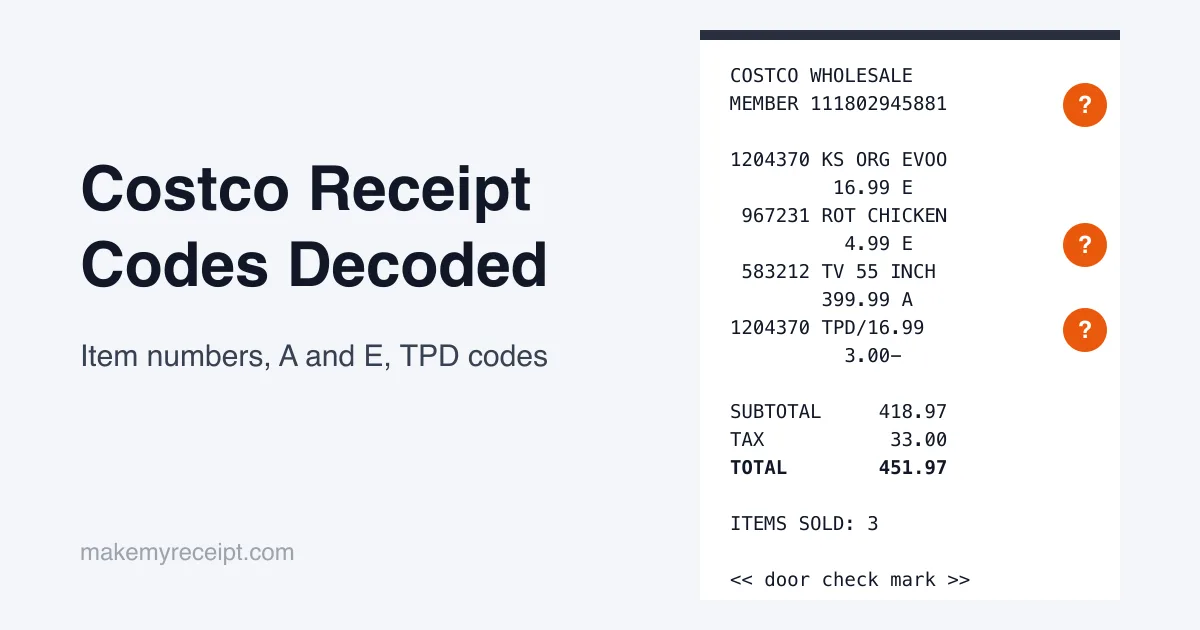
Here is the thing most "Costco receipt codes" guides get wrong before the first paragraph: they are not about the receipt. The famous codes, the .97 endings, the .00 markdowns, the asterisk, all live on the shelf price tag. The receipt has its own, smaller vocabulary: item numbers, the A and E letters, deduction lines marked TPD or IRC, and your membership number at the top. This guide covers both sets and keeps them straight, because knowing which surface a code lives on is most of the answer.
As with the other retailers in this series, Costco publishes no official key to any of it. Where a meaning is shopper folklore rather than documented fact, we say so. For the anatomy every US receipt shares, start with our guide on how to read a receipt; this is the Costco-specific chapter.
What Actually Prints on a Costco Receipt
| Element | What it is | How solid? |
|---|---|---|
| Membership number | Your account, printed in the header with warehouse and date | Commonly reported |
| Item number | Costco's internal product ID, one per line | Costco's own systems use it |
| Abbreviated item name | Heavily shortened description | Universal practice |
| A | Reported as taxable item | Shopper observation only |
| E | Reported as tax-exempt item | Shopper observation only |
| TPD | Reported as a Costco-funded markdown | Reported, unofficial |
| IRC | Reported as an instant rebate (manufacturer-funded) | Reported, unofficial |
| Negative line under an item | An Instant Savings deduction | Confirmed by how Instant Savings work |
| The marker slash | Added at the exit so the receipt can't be reused | Widely reported by employees |
Notice what is not in this table: the asterisk and the price endings. We get to those below, but they belong to the price tag.
Item Numbers: The Code Worth Writing Down
Every line on a Costco receipt leads with an item number rather than a full product name. That number is Costco's internal product ID, and it is the identifier the warehouse itself uses: Costco's own customer service pages answer item-number questions because it is how products are tracked for lookups, returns, and price adjustments.
The practical tip is simple. Costco's receipt descriptions are abbreviated to the point of riddles ("KS ORG EVOO" and friends), so when a line stumps you weeks later, the item number is the part that can still identify the product. If you expect to want a price adjustment or a return on something, a photo of the receipt preserves the number. Costco does not document the numbering scheme itself, so ignore any guide claiming specific digits encode categories.
A and E: The Tax Letters, Honestly Labeled
The letters that appear next to prices, most often A and E, are the receipt codes people actually search for, and the honest answer is that no official legend exists. The common reading, compiled from shopper observations, is that A marks a taxable item and E a tax-exempt one.
That reading is plausible and probably right at your warehouse, but it is worth knowing why it cannot be universal: whether your rotisserie chicken or paper towels are taxed is a question of state law, not Costco policy. The same item can be E in one state and A in another. If a letter matters to you, the two minute verification method in our receipt-reading guide settles it: add up the flagged items, apply your local rate, and compare against the tax line.
TPD, IRC, and How Instant Savings Print
When an Instant Savings deal applies, the receipt does not quietly lower the unit price. The item prints at its regular price, and a separate negative line appears under it carrying the deduction. The line labels are reported to expand as TPD for a Costco-funded markdown and IRC for an instant rebate funded by the manufacturer. Costco applies Instant Savings automatically, with no coupon clipping, which is why the deduction shows up as a register line rather than a scanned coupon.
For you, the distinction between TPD and IRC changes nothing about the math; both are money off. It only tells you who paid for the discount. Our receipt abbreviations glossary covers the equivalent coupon codes (SC, MC, MFR) that other chains print.
The Price-Tag Codes Everyone Mixes In
Now the folklore that fills every other guide, correctly filed under price tags rather than receipts. The system, reported consistently across outlets going back to Consumerist coverage years ago, and sourced to employees and dedicated shoppers rather than to Costco:
- .99 endings are the regular price.
- .97 is a corporate or buyer markdown, the closest thing Costco has to a clearance sticker.
- .00 and .88 are read as manager markdowns, often the clear-it-now price on the last units, returns, or floor models.
- .49, .79, .89 and similar odd endings are read as manufacturer-discounted deals.
Costco has never confirmed or denied any of this, and warehouses vary, so treat it as a well-tested rumor rather than policy.
The asterisk in the tag's corner is the most famous marker, reported to mean the item is pending delete: once current stock sells through, the warehouse may not reorder it. Shoppers call it the death star. It is not a guarantee of disappearance, since items return in new packaging, different sizes, or as Kirkland Signature versions, and one warehouse can drop a product while another restocks it. But if something you love wears an asterisk and a .97 price, that is the strongest buy-it-now signal Costco emits.
The Door Check and the Marker Slash
The exit check is part of the receipt's life cycle, so it belongs in this guide. Costco management has been unusually direct about its purpose: making sure members were not overcharged or undercharged, not catching shoplifters. Employee accounts fill in the mechanics: checkers compare the item count on the receipt against the cart, watch for double scans and missed under-cart items like water cases, and reportedly flag big-ticket items (jewelry and anything over roughly $300) for a supervisor's initials. Suspected theft is handled long before the door.
The highlighter slash the checker draws has a specific job too: it marks the receipt as used, so the same slip cannot walk a second cart of goods out of the building.
Your Membership Is the Real Receipt
The deepest difference between Costco and most retailers is that the paper slip is a convenience, not the record. Every purchase is tied to your membership number, and that account does things paper cannot:
- Two years of receipts online. Costco's official lookup keeps up to two years of in-warehouse purchases in your Costco.com account and app under Orders & Returns, browsable in six-month increments. New purchases can take up to 24 hours to appear. Instacart orders, food court, optical, travel, and gas bought before late September 2024 are excluded, and pharmacy purchases show only as "Universal" for privacy.
- Duplicates on demand. For anything older than two years, the membership counter can retrieve it with your photo ID, membership number, and purchase date.
- Returns without paper. Costco's return policy is a satisfaction guarantee with few exceptions (electronics carry a 90-day window), and because the transaction lives on your account, the warehouse can pull it up without the slip.
The membership scanners Costco rolled out at entrances starting in 2024 complete the loop: entry, purchase, and returns all run through the same account. If you are reconstructing spending for a budget or a tax record, that two-year history is the place to start, and our grocery spending statistics report shows how warehouse trips compare with typical grocery bills.
Frequently Asked Questions
What does A or E mean on a Costco receipt?
A is commonly reported to mark a taxable item and E a tax-exempt one, but these are shopper observations, not an official Costco legend. Which items carry which letter depends on your state's tax rules, since groceries are taxed differently across states. If it matters, check whether the flagged items feed the tax line.
What are TPD and IRC on a Costco receipt?
They label the negative deduction lines under a discounted item. TPD is reported to be a Costco-funded markdown and IRC an instant rebate funded by the manufacturer. Either way, the discount is applied automatically at the register; Costco's Instant Savings never require clipping a coupon.
What does the asterisk mean at Costco?
The asterisk is a shelf price-tag signal, not a receipt code. It is widely reported to mean the item is pending delete: once the warehouse sells its current stock, it may not be reordered. Shoppers nickname it the death star. The item can still come back later, sometimes in new packaging or as a Kirkland Signature version.
Why does Costco check receipts at the door?
Costco management has said the check is about accuracy, not shoplifting: making sure members were not overcharged or undercharged. Employees report that checkers compare the item count against the cart, glance at high-value items, and watch for double scans. The marker slash exists so the same receipt cannot be used twice.
Can I get a copy of a Costco receipt?
Yes. Costco keeps up to two years of in-warehouse purchases in your online account and app under Orders & Returns, viewable in six-month increments. New purchases can take up to 24 hours to appear. For anything older, the membership counter can pull it up if you bring photo ID, your membership number, and the purchase date.
Does Costco accept returns without a receipt?
In practice, yes. Costco's satisfaction guarantee applies to almost everything it sells, and because every purchase is tied to your membership number, the warehouse can look the transaction up without paper. Electronics are the main exception to the open-ended window: they must go back within 90 days.
What do Costco's price endings like .97 and .00 mean?
These are price-tag conventions, reported by employees and shoppers rather than published by Costco. .99 is the regular price, .97 is widely read as a corporate markdown, .00 and .88 as manager markdowns, and endings like .49 or .79 as a manufacturer-funded discount. Treat them as folklore with a good track record, and expect variation between warehouses.
The Bottom Line
Keep the two surfaces straight and Costco's codes get simple. The receipt speaks in item numbers, A and E letters, and TPD or IRC deduction lines. The price tag speaks in endings and asterisks. And behind both sits the membership account, which remembers two years of purchases better than any thermal slip will. When a code still puzzles you, the decode method in our receipt-reading guide works at Costco the same as anywhere, and if you want to see how the pieces of a warehouse receipt fit together, our Costco receipt template rebuilds the format line by line.
Ready to create your receipt?
Try our free receipt maker with customizable templates.
Open Receipt Builder